 EHR vs EMR vs HMS
The healthcare industry is rapidly moving towards digital transformation. Hospitals, clinics and healthcare professionals are adopting advanced software solutions to improve patient care, simplify administrative operations and manage medical information more efficiently. Three commonly used terms in healthcare technology are EHR (Electronic Health Record), EMR (Electronic Medical Record) and HMS (Hospital Management System).
Although these terms are often used interchangeably, they serve different purposes in healthcare management. Understanding the difference between EHR, EMR and HMS can help hospitals, clinics and healthcare providers choose the right software for their operational and clinical requirements.
In this blog, we will explain what EHR, EMR and HMS mean, their features, benefits and how they work together to improve healthcare delivery.
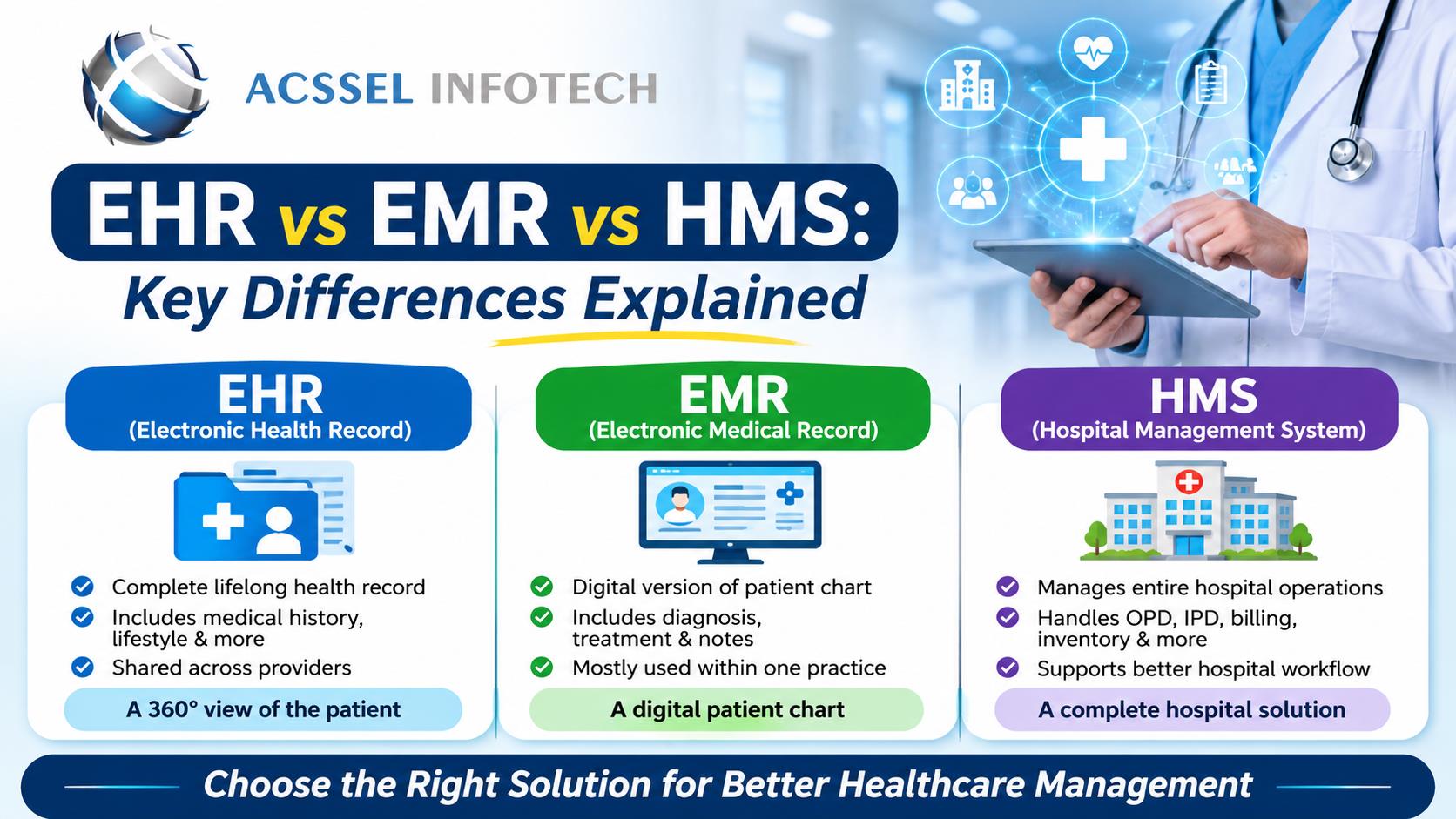
An Electronic Health Record (EHR) is a digital record of a patient's overall health information. It maintains a comprehensive medical history that can include diagnoses, prescriptions, laboratory reports, allergies, treatment plans and previous medical records.
Unlike traditional paper-based records, EHR systems allow authorised healthcare professionals to access and exchange patient information across different healthcare settings, depending on system integration and interoperability.
For example, when a patient visits a general physician and is later referred to a specialist, relevant health information can be shared electronically through an interoperable EHR system. This helps healthcare professionals understand the patient's medical history and make informed treatment decisions.
Key Features of EHR Software
EHR software generally includes patient medical history management, digital prescriptions, laboratory reports, diagnostic information, treatment documentation, medication records and secure information sharing.
Benefits of EHR Software
EHR software improves continuity of care by making patient information more accessible to authorised healthcare professionals. It can reduce duplicate medical tests, improve coordination between healthcare providers and support better clinical decision-making.
It also helps healthcare organisations maintain organised medical records and improve the overall patient experience.
An Electronic Medical Record (EMR) is a digital version of a patient's medical chart maintained by a particular doctor, clinic or healthcare organisation.
It primarily focuses on recording patient information during consultations and treatment within a healthcare facility. Doctors use EMR software to document symptoms, diagnoses, prescriptions, medical observations and treatment progress.
For example, when a patient visits a clinic for a regular consultation, the doctor can access the patient's previous medical records, update the diagnosis and generate a digital prescription using EMR software.
EMR systems are particularly useful for individual clinics, diagnostic centres and healthcare facilities that want to replace traditional paper-based documentation.
Key Features of EMR Software
EMR software commonly includes patient registration, digital medical records, doctor consultation notes, diagnosis management, prescription generation, medical history tracking and clinical documentation.
Benefits of EMR Software
EMR software helps doctors maintain accurate patient records, reduces paperwork and makes medical information easier to retrieve. It also supports better follow-up consultations by allowing doctors to review previous diagnoses and treatment details.
For smaller healthcare practices, EMR software can simplify clinical documentation and improve consultation management.
A Hospital Management System (HMS) is a comprehensive software solution designed to manage the administrative, operational and clinical activities of a hospital.
Unlike EMR, which primarily focuses on patient medical records, HMS covers multiple hospital departments and connects their daily operations through a centralised digital platform.
An HMS helps hospitals manage everything from patient registration and appointment scheduling to billing, pharmacy, laboratory operations, inventory and discharge management.
For example, when a patient visits a hospital, the HMS can manage registration, doctor appointments, consultation billing, laboratory requests, pharmacy transactions and discharge processes through connected modules.
Key Features of HMS Software
A modern HMS may include patient registration, OPD management, IPD management, appointment scheduling, doctor management, billing and invoicing, pharmacy management, laboratory management, inventory management, insurance management and reporting.
Depending on the software, it may also integrate EMR and EHR capabilities to support digital medical record management.
Benefits of HMS Software
HMS software helps hospitals streamline daily operations, reduce manual administrative work and improve coordination between departments.
It provides better visibility into hospital activities, supports financial management and helps administrators monitor operational performance.
By connecting different departments, an HMS can improve workflow efficiency and create a more organised healthcare environment.
Although EHR, EMR and HMS are all important healthcare technology solutions, their primary purposes are different.
| Comparison | EHR | EMR | HMS |
|---|---|---|---|
| Full Form | Electronic Health Record | Electronic Medical Record | Hospital Management System |
| Primary Purpose | Managing comprehensive patient health records | Managing clinical medical records | Managing hospital operations |
| Main Focus | Patient health information | Patient diagnosis and treatment | Administrative and clinical workflows |
| Users | Authorised healthcare providers | Doctors and clinical staff | Hospital administrators and staff |
| Medical Records | Comprehensive health history | Clinical records within a practice or organisation | May include integrated EMR/EHR records |
| Department Coverage | Clinical information across care settings | Primarily clinical documentation | Multiple hospital departments |
| Main Benefit | Continuity of patient care | Better medical documentation | Improved hospital efficiency |
The most important distinction is that EHR and EMR primarily focus on patient health information, whereas HMS focuses on managing the overall operations of a hospital. However, modern healthcare software solutions can combine these capabilities.
EHR, EMR and HMS are not necessarily competing technologies. They can work together as interconnected components of a modern healthcare ecosystem.
For example, consider a patient visiting a multi-specialty hospital.
First, the HMS manages patient registration, appointment scheduling and billing. During the consultation, the doctor uses EMR functionality to record symptoms, diagnoses, prescriptions and treatment details.
These clinical records can contribute to a broader EHR, which maintains the patient's health information over time and supports secure sharing with other authorised healthcare providers when interoperability is available.
This integrated approach helps hospitals connect administrative activities with clinical information and improve coordination throughout the patient journey.
Choosing between EHR, EMR and HMS depends on the size of your healthcare organisation, its operational requirements and the type of services it provides.
A small clinic may primarily need EMR software to manage patient consultations, prescriptions and medical histories.
A specialist healthcare centre may benefit from EHR capabilities to maintain comprehensive patient records and support continuity of care.
A multi-specialty hospital generally requires HMS software to manage different departments, including OPD, IPD, billing, pharmacy, laboratory and inventory.
Hospitals looking for a complete digital transformation should consider an integrated healthcare management solution that combines hospital operations with electronic medical records and appropriate EHR capabilities.
Before selecting software, healthcare providers should evaluate data security, user access controls, reporting capabilities, integration options, scalability and ongoing technical support.
Digital healthcare solutions are becoming increasingly important for hospitals and clinics. Managing patient information through paper records and disconnected systems can create administrative challenges, increase documentation workload and make information retrieval difficult.
Modern healthcare software helps address these challenges through centralised data management, automated workflows and improved departmental coordination.
With the right technology, healthcare providers can simplify daily operations, maintain organised patient records, improve resource utilisation and focus more effectively on delivering quality patient care.
EHR, EMR and HMS play different but complementary roles in modern healthcare. EMR focuses on digital clinical documentation, EHR supports a broader and more continuous view of patient health information, while HMS manages the overall administrative and operational activities of hospitals.
Understanding these differences is essential when selecting healthcare software. Rather than choosing a system based only on its name, healthcare providers should evaluate its actual features, integration capabilities and ability to meet their requirements.
Acssel Infotech provides healthcare technology solutions designed to support hospitals, clinics and healthcare professionals in their digital transformation journey. With the right healthcare management software, healthcare organisations can simplify operations, improve information management and build a more efficient healthcare environment.