Ultimate Dental Practice Management Software
Missed appointments, denied insurance claims, and an overwhelmed front desk quietly drain thousands of dollars from dental practices every month. Dental practice management software exists to fix exactly that problem, by pulling scheduling, billing, and patient communication into one connected system instead of three disconnected ones.
If you've ever wondered whether switching software is worth the disruption, you're not alone. It's one of the most common questions practice owners ask before committing budget and staff time to a new system.
This guide breaks down how dental practice management software works, what it costs in 2026, and how to pick the right platform for your practice size and workflow. Nilesh Dubey, Technical Director at Acssel Infotech, has spent 14+ years leading healthcare technology teams and has worked directly with hospitals, IVF centers, and dental clinics as they evaluate, implement, and troubleshoot practice management systems. By the end, you'll know which features actually matter, which red flags to avoid, and how to move forward with confidence.
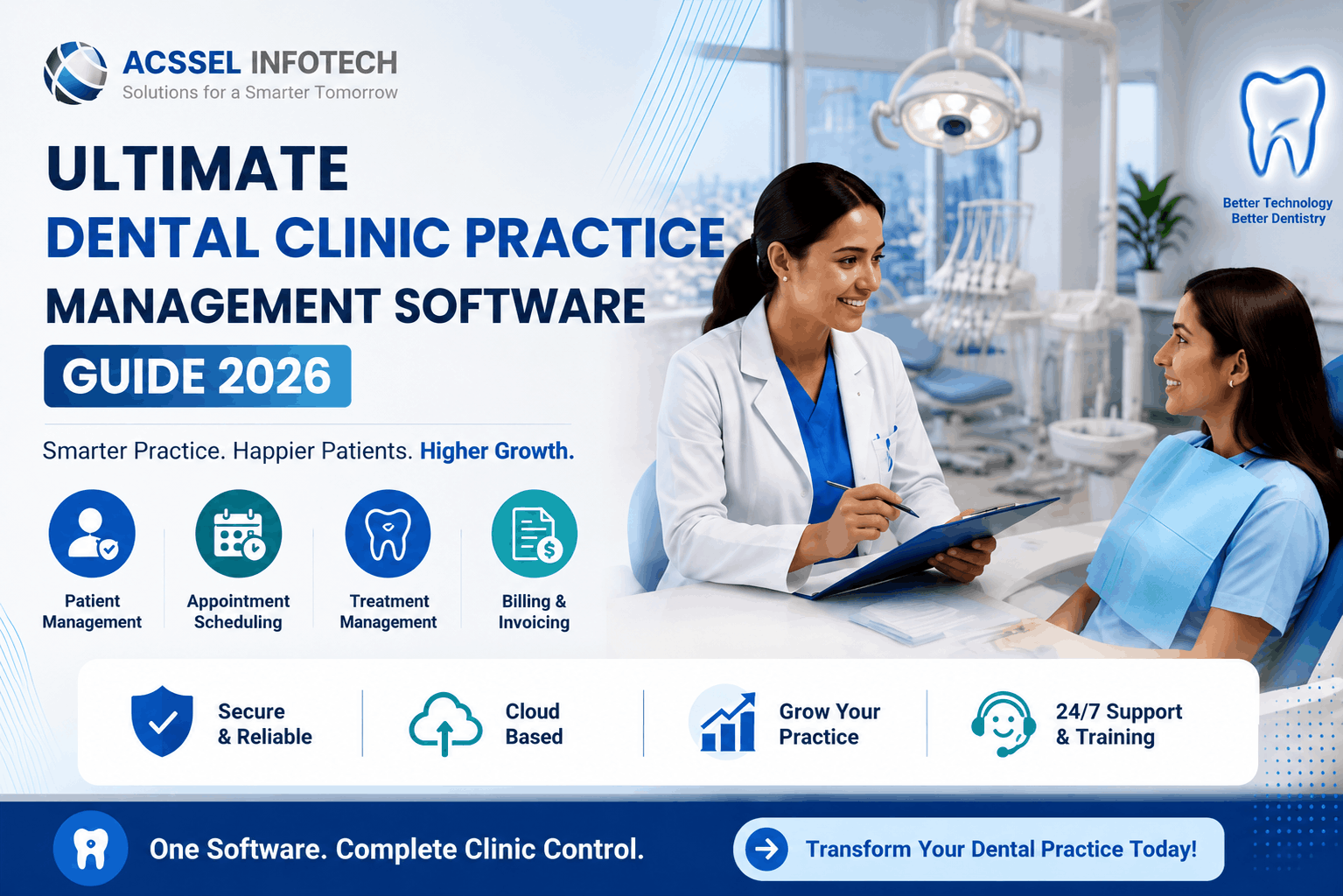
Dental clinic management software sits at the center of daily clinic operations. It connects scheduling, patient records, and billing so front-desk staff and clinicians work from the same real-time data instead of separate spreadsheets and paper charts. This shift is also why data security frameworks like HIPAA-compliant cloud hosting have become a baseline requirement rather than a nice-to-have.
Dental practice management software is a digital platform that manages scheduling, billing, insurance claims, and patient records in one system. It replaces paper charts and manual bookkeeping with automated workflows. A solo practice can use it to confirm appointments by text and post payments without extra staff hours.
The global dental practice management software market was valued at roughly $3.0 billion in 2025 and is projected to grow to $3.3 billion in 2026, expanding at a compound annual growth rate near 10.9% through 2033 (Grand View Research, 2026). That growth reflects how many practices are still migrating off legacy, disconnected tools.
Patient volume, staffing shortages, and rising compliance expectations have made manual, paper-based workflows harder to sustain. Practices that still rely on phone-only scheduling and manual claim entry tend to lose the most time to avoidable rework. The entity worth knowing here is the practice management system, or PMS, which is now the operational backbone most dental offices build around.
Dental practices need practice management software because manual processes cannot keep pace with patient volume and compliance demands. It automates appointment reminders, insurance verification, and claim submission. A busy multi-provider clinic can meaningfully cut administrative hours by letting the system handle routine confirmations and billing checks.
In a study spanning more than 1.6 million dental appointments across 64 practices, automated reminders reduced no-shows by nearly 23% compared with manual reminder methods (Sesame Communications, Dental Tribune, 2017). More recent industry data shows SMS reminders alone can cut no-show rates by 38% to 50% compared with no reminder system at all (PatientDesk.ai, 2026).
Not every platform covers the full practice workflow, so it helps to separate must-have features from nice-to-have extras before you start comparing vendors. A key concept here is claim scrubbing, the automated check that flags coding errors against CDT (Current Dental Terminology) codes before a claim is ever submitted.
The most important dental practice management software features are scheduling, insurance billing, patient communication, and reporting. Strong platforms include automated claim scrubbing that checks codes before submission. A practice opening a second location, for example, needs multi-office scheduling and centralized reporting built in from day one.
Dental practices commonly see insurance claim denial rates of 15% to 20%, largely from coding errors and missing attachments — a gap that automated claim scrubbing is specifically designed to close (Lassie AI, 2026). Industry benchmarks recommend practices target a denial rate under 5% (Teero, 2026).
Budget is often the deciding factor once a shortlist is narrowed down, and pricing structures vary widely by deployment model and provider count. This is where the concept of total cost of ownership matters more than the advertised sticker price, since implementation, support, and add-on modules all affect the real monthly spend.
Dental practice management software typically costs $50 to $350 per provider per month for solo and small practices. Established on-premise platforms often run $400 to $800 per month per location. Cloud-based subscriptions usually bill per provider, while larger DSOs negotiate custom enterprise pricing across multiple locations.
Established platforms like Dentrix and Eaglesoft commonly run $400 to $800 per month in licensing before add-on modules, while cloud-native options such as Open Dental and Curve Dental often start lower, in the $150 to $350 per month range (The Molar Report, 2026). Perpetual, one-time-license pricing is also shrinking industry-wide as subscription models take over (Mordor Intelligence, 2026). Vendors in India follow a similar shift: Acssel Infotech, for example, prices its Dental Clinic Management module in tiered Economy, Business, and Executive plans, billed monthly, quarterly, or yearly, with a free trial available before you commit.
Deployment model shapes cost, security responsibility, and day-to-day access far more than most buyers expect going in. On-premise deployment keeps data on a local server the practice maintains, while cloud, or web-based, deployment hosts data off-site and delivers it over the internet.
Cloud-based dental practice management software is hosted off-site and accessed through the internet. On-premise software runs on local servers that the practice owns and maintains. Cloud systems typically offer lower upfront cost and remote access from any device. On-premise systems appeal to practices that want full local control over their data.
Market analysts consistently point to web and cloud-based deployment as the fastest-growing segment of the dental practice management software market, driven by scalability, remote access, and lower upfront capital requirements (Coherent Market Insights, 2026). Even so, a meaningful share of established practices still run on-premise systems they've used for years, so the "right" choice depends heavily on your existing infrastructure and growth plans.
Choosing the right system starts with mapping your practice's actual workflows and pain points, not just browsing feature lists. A rushed decision here is one of the most expensive mistakes a practice can make, since re-implementing a new PMS later means retraining staff and migrating years of patient data.
Choosing dental practice management software starts with listing your core workflows. Then compare shortlisted vendors on integration, support quality, and total cost of ownership. Request live demos instead of relying on sales decks alone. A growing multi-location practice should prioritize scalability and centralized reporting over the cheapest plan.
Practices using a single connected system for insurance verification, claim submission, and payment posting process claims roughly 33% faster and handle 17% more claims overall than practices juggling disconnected tools (The Dental App, 2026). Vendors built specifically for dental workflows are worth shortlisting for this reason: Acssel Infotech's Dental Clinic Management software, for instance, bundles chairside appointment scheduling, procedure-based billing, X-ray and imaging management, and treatment-package tracking into one system, which is the kind of single-platform coverage this section recommends looking for.
Trust & Authority
"The clinics that struggle most aren't understaffed — they're running chairside operations on tools built for a different decade." — Nilesh Dubey, Director, Acssel Infotech .
Original Insight :
Acssel Infotech has spent 6 years building healthcare management software and now supports 150+ hospitals and clinics, processing more than 150,000 admissions and 200,000 OPD patient visits a year across its platform. Its Dental Clinic Management module applies that same connected-system approach to chairside work: appointment scheduling, procedure-based billing, X-ray and imaging management, treatment-package tracking, and inventory management for dental materials all run from one place, so dentists spend less time reconciling separate tools and more time with patients.
Dental practice management software is no longer optional infrastructure — it's the operational core of a modern practice. The right system reduces no-shows, speeds up insurance claims, and frees your front desk from repetitive manual work. Whether you choose a cloud-based or on-premise platform, prioritize the features that match your actual workflow over the longest feature list. Practices that treat this as a strategic decision, not just a software purchase, see the clearest returns.
The fastest way to know if a platform fits ypur practise is to see it running on your own workflows. Book a free demo of Acssel's Dental Clinic Management software and get a walkthrough tailored to your practice size and current pain points.
Nilesh Dubey, Director, Acssel Infotech
Nilesh Dubey is the Director at Acssel Infotech, a Navi Mumbai-based healthcare software company serving 150+ hospitals and clinics across India. With 14+ years leading technical teams, he has worked on the strategy and delivery of Acssel's practice management platforms, including its Dental Clinic Management software, and has helped healthcare providers implement systems that fit their real day-to-day workflows.
What is dental practice management software?
Dental practice management software is a digital platform that combines scheduling, billing, insurance claims, and patient records into one connected system for a dental practice.
How much does dental practice management software cost in 2026?
Most solo and small practices pay between $50 and $350 per provider per month, while established on-premise platforms often run $400 to $800 per month per location before add-ons.
Is cloud-based dental practice management software secure?
Yes, reputable cloud-based platforms are built to be HIPAA-compliant, using encryption and access controls, though practices should always confirm a vendor's specific security certifications.
How long does it take to switch dental practice management software?
Migrations typically take a few weeks to a few months, depending on data volume, staff training needs, and how much historical patient data must be transferred.
Does Acssel Infotech offer a free trial for its dental clinic software?
Yes. Acssel Infotech offers a free trial of its Dental Clinic Management module before you move to a paid Economy, Business, or Executive plan, so you can test the scheduling, billing, and imaging workflow on your own practice first.