Cosmetic Clinic Software
Walk into a mid-sized hospital in India today, and you may still see paper registers at the front desk, lab reports being carried manually to doctors, and pharmacy stock being reconciled late at night. This is not unusual. Across many small and mid-sized hospitals, digitization has arrived unevenly. Some departments use software. Others rely on paper. Very few systems actually connect with each other.
Hospital management software exists to close this gap. It does not replace clinical judgment or bedside care. Instead, it connects the operational and administrative backbone of a hospital: registration, billing, pharmacy, laboratory, inventory, and compliance reporting for schemes such as Ayushman Bharat.
India’s hospital software market is growing rapidly. The India hospital information system market generated about USD 4.08 billion in revenue in 2024 and is projected to reach roughly USD 12.9 billion by 2030, growing at a 21.3% CAGR. Cloud-based deployment is leading this growth.
Adoption, however, is not uniform. A 2026 survey by Ken Research covering 2,000 hospital decision-makers across India found a clear pattern: hospitals digitize money modules first and clinical modules last. Billing and revenue management is live in 81% of hospitals and patient registration in 78%. But EHR and clinical notes reach only 42%, radiology and PACS 38%, and analytics dashboards just 29%.
This means most hospitals run on partial systems. A hospital may have fully digital billing while clinical notes remain on paper. The data that drives quality and analytics stays offline.
Adoption is also a journey. Vendor selection and data migration take about four months. Core billing and registration modules go live around the six-month mark. Clinical modules and analytics push full adoption past 14 to 18 months. This is why phased rollouts now dominate over big-bang implementations.
A hospital management system, often used interchangeably with hospital information system, is an integrated software platform that runs both clinical and administrative operations. Instead of separate registers for front desk, pharmacy, lab, and accounts, an HMS connects these functions. A single patient visit flows from registration to discharge and final billing.
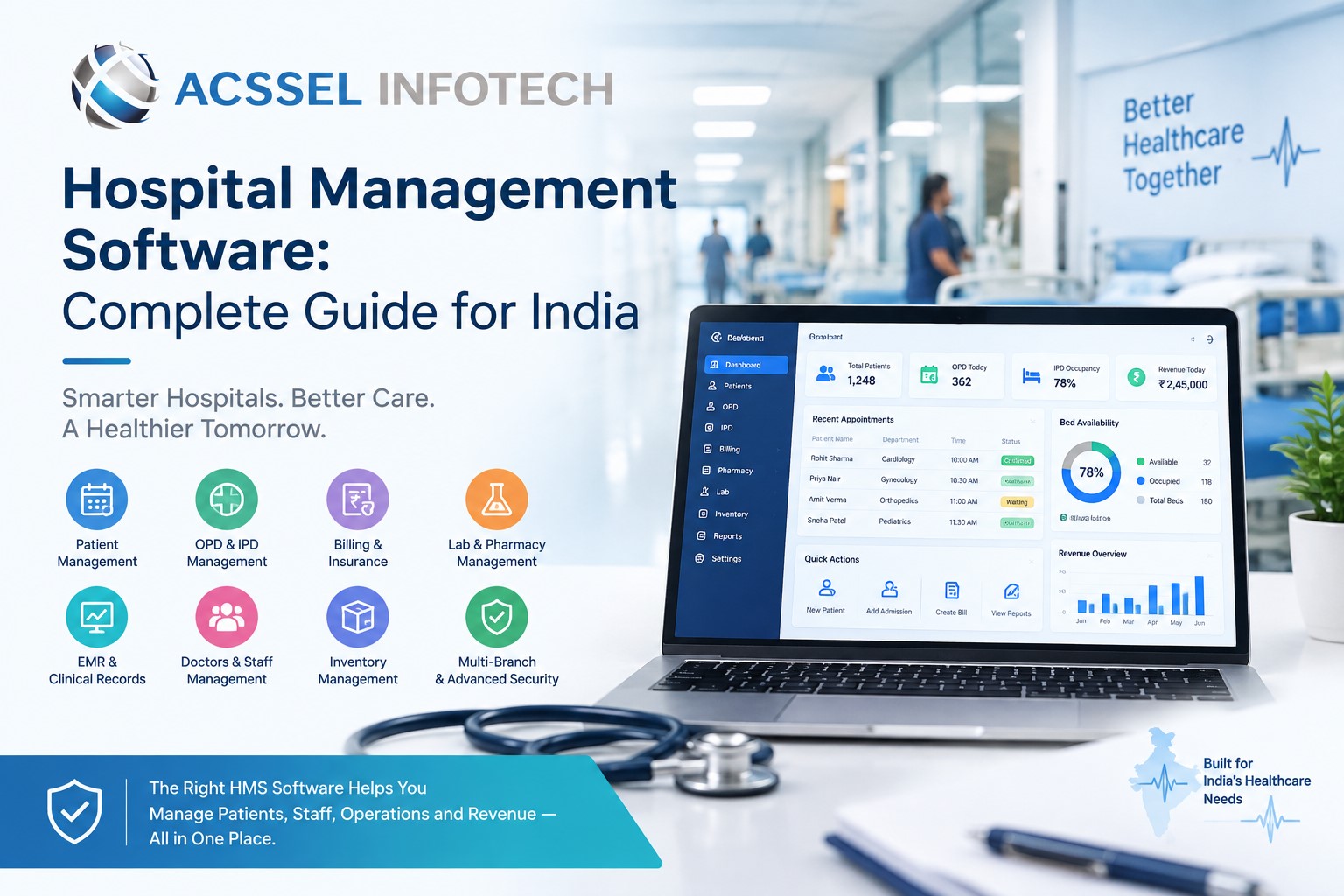
Here are the core modules every Indian hospital should evaluate:
The strength of any HMS lies in how well its modules work together. A receptionist should register a patient. A doctor should record clinical notes. A lab technician should upload results. A pharmacist should dispense medication. The billing desk should settle an insurance claim. All against the same patient record.
No guide to hospital management software in India is complete without addressing Ayushman Bharat Digital Mission. This national initiative is reshaping what hospitals expect from their software.
Ayushman Bharat and other government health schemes require digital claim submission and reporting. This effectively pulls hospitals participating in these schemes toward at least some software adoption. NABH accreditation, increasingly chased by hospitals after insurance empanelment and corporate tie-ups, also pushes documentation standards that are hard to sustain on paper.
ABDM-compliant software must support ABHA creation and linking, health-record interoperability, and compliance with National Digital Health Mission guidelines. For medical colleges, the National Medical Commission has mandated integration of HMIS with ABDM-HMIS dashboards. Hospitals must verify whether their existing software is listed as an ABDM-enabled solution before proceeding with integration.
This is not only about compliance. It is also about patient expectations. People managing most of their lives through apps now expect basic digital touchpoints from a hospital: appointment booking, digital reports, and seamless records.
A 2026 buyer’s guide for Indian hospitals emphasizes that a shortlist must prove ABDM and ABHA linking, NABH-ready audit trails, and correct GST on taxable items. Beyond compliance, several practical factors matter.
ACSSEL Infotech’s hospital management system is built around the reality of Indian healthcare operations. The platform covers every department from outpatient and emergency care to admissions, diagnostics, and discharge. It connects all departments under a single platform to manage patient data, billing, pharmacy, lab reports, and HR functions.
Key capabilities include:
The platform is designed to be user-friendly, easy to learn, and modular. Hospitals can start with core modules and expand as their needs grow.
Based on industry surveys and implementation experiences, here are mistakes that come up often enough to flag before signing any contract.
Hospital management software in India has moved from a nice-to-have to a fundamental operational requirement. Government schemes demand digital reporting. Patients expect digital touchpoints. Accreditation bodies raise documentation standards. The question is no longer whether to adopt an HMS. It is about choosing the right one and implementing it well.
The right platform reduces waiting times, tightens revenue leakage, keeps patient records accurate, and helps meet regulatory expectations. The wrong one creates duplicate data entry, billing disputes, and staff frustration.
For Indian healthcare providers, whether a single-specialty clinic in a tier-2 city or a multi-specialty hospital chain, the key is to start with a clear understanding of operational priorities. Evaluate vendors against ABDM and NABH compliance requirements. Plan for a phased rollout that delivers quick wins while building toward full clinical integration.
ACSSEL Infotech’s hospital management solutions are designed to support this journey, with modular architecture, ABDM-ready capabilities, and a focus on the operational realities of Indian hospitals and fertility centres. To explore how ACSSEL can support your facility’s digital transformation, visit www.acssel.com.