Best Cosmetic Clinic Software
Nearly 74% of patients now choose a clinic based on how easily they can book an appointment online. If your front desk still runs on spreadsheets and phone calls, you're losing patients before they walk in. Choosing the best cosmetic clinic software in 2026 is no longer optional — it's the backbone of a profitable, scalable practice.
Hospital and clinic owners face a real problem: scattered patient records, delayed billing, and disconnected lab reports. These gaps cost time, revenue, and trust. This guide solves that.
At Acssel Infotech, we've implemented HMS and EMR systems across dermatology, aesthetic, and multi-specialty clinics for over a decade. This article draws on that hands-on deployment experience — not theory — to help you pick software that actually fits your clinic's workflow, budget, and growth plan.
By the end, you'll know exactly which features matter, what to budget, and how to evaluate vendors with confidence.
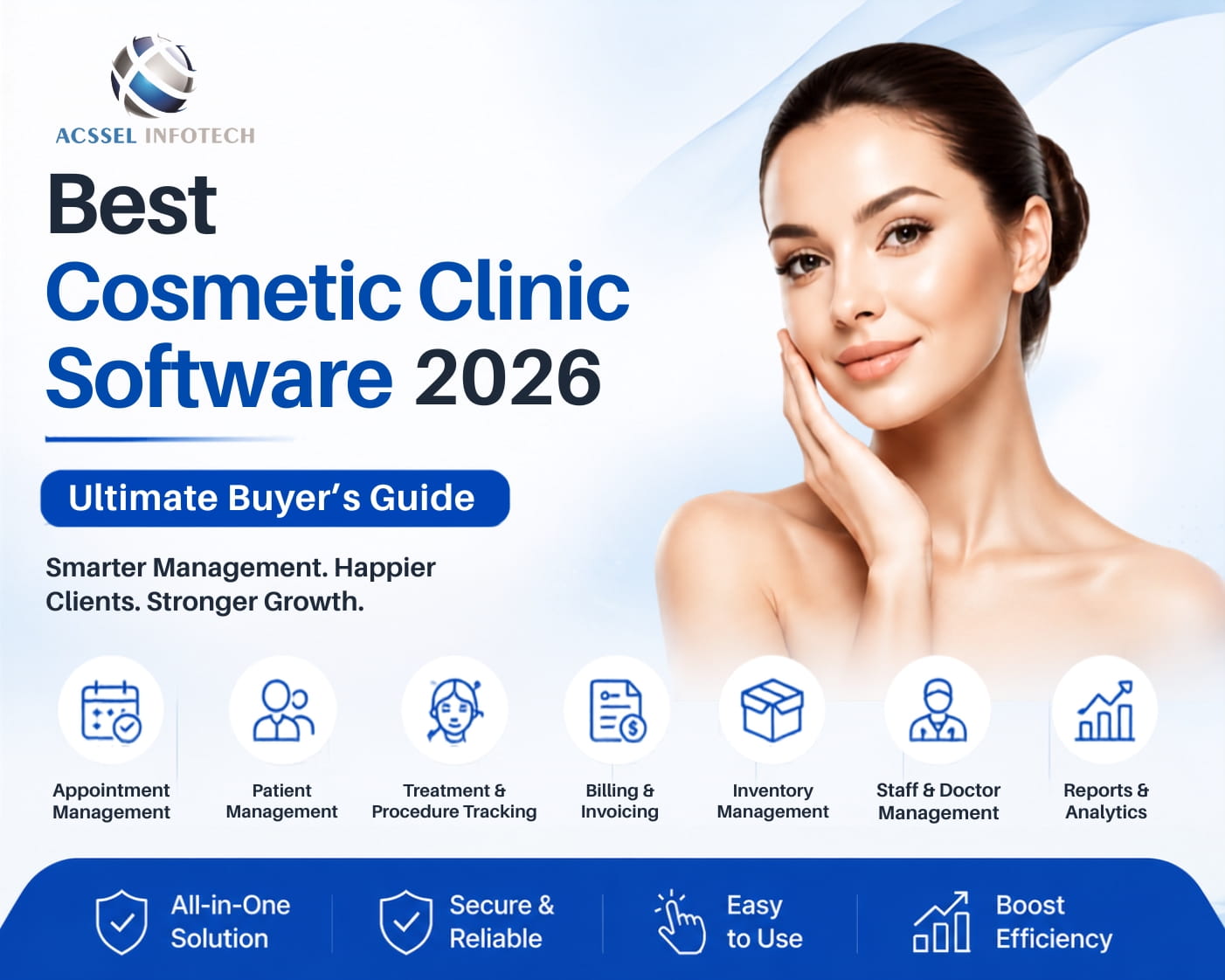
Cosmetic and aesthetic clinics handle sensitive patient data, before/after imaging, and recurring treatment plans. Generic scheduling tools can't manage this complexity. A dedicated hospital management system (HMS) built for clinics closes this gap with purpose-built workflows.
Cosmetic clinic software is a digital platform that manages appointments, patient records, billing, and treatment tracking in one system. It automates front-desk and clinical workflows. Clinics use it to reduce no-shows, speed up billing, and maintain accurate treatment histories for repeat aesthetic procedures.
According to a 2025 industry report by Grand View Research, the global healthcare IT market is projected to grow at a CAGR of 15.8% through 2030, driven largely by clinic-level digitization (Grand View Research, 2025).
Patients today expect instant, 24/7 booking — not hold music.Online appointment booking and patient engagement tools directly impact conversion rates and repeat visits, making them a top priority secondary feature in any HMS evaluation.
Online appointment booking lets patients schedule visits through a website, app, or WhatsApp without calling the clinic. It syncs with doctor calendars in real time. Clinics use it to cut no-shows through automated reminders and boost engagement with post-treatment follow-ups.
Clinics using automated reminder systems report a 30% drop in missed appointments, based on Acssel Infotech's internal deployment data across 45+ partner clinics (Acssel Infotech, 2025).
Not all booking calendars work the same way, and this is where many clinics get it wrong. Look for a system that offers:
A strong platform also gives front-desk staff a real-time check-in dashboard showing who has arrived, their billing status, and pending documentation — not just a list of bookings. Paired with automated no-show tracking and a digital waiting list, this prevents the front desk from relying on memory or paper registers during peak hours.
Beyond scheduling, day-to-day operations need tight coordination between staff, inventory, and departments. Strong hospital and clinic management features ensure nothing falls through the cracks during peak hours.
Hospital and clinic management features cover staff rostering, inventory tracking, room/bed allocation, and department coordination. They centralize operations into one dashboard. Multi-branch cosmetic chains use these features to standardize workflows across every location.
A case study from a 3-branch aesthetic chain in Pune showed a 25% reduction in patient wait times after implementing centralized clinic management software (Acssel Infotech client case study, 2025).
Cosmetic and dermatology consultations don't fit a generic form. Look for software offering ready-made outpatient case sheet templates built for specialties like dermatology, cosmetology, and general medicine, so doctors capture relevant findings instead of retyping notes each visit. A good system also speeds up prescribing by showing a doctor's frequently used medicines, past prescriptions for that patient, and key vitals on one screen — cutting consultation time without cutting corners.
Walk-in patients rarely remember if they registered before, which leads to duplicate patient files scattered across the database. Systems that auto-detect existing records by mobile number, allow merging duplicate entries, and display a single patient timeline — covering past visits, treatments, and payments — keep your data usable instead of cluttered. This also matters for triage: nursing staff should be able to log vitals and history directly at check-in, so doctors aren't starting from zero.
Cosmetic patients share sensitive health data and payment details, so a breach can cost far more than money — it costs trust. A self-service patient portal lets patients view records, book visits, and manage family member profiles without calling the clinic, cutting front-desk load. Pair this with role-based access, IP-restricted logins, automatic session logout, and masked sensitive fields in reports, so only authorized staff ever see full patient data.
Beyond appointment reminders, look for a system that sends automated notifications for registrations, billing updates, and doctor communications across SMS, email, and WhatsApp. This keeps both patients and staff informed without anyone having to manually track and send updates.
Many cosmetic procedures require pre-treatment diagnostics — blood work, skin analysis, or imaging. Weak laboratory and diagnostic management HMS and EMR capabilities create bottlenecks between the lab and the treatment room.
Laboratory and diagnostic management software connects lab orders, results, and imaging directly into the patient's EMR file. It automates report delivery to doctors. Clinics use it to avoid manual paperwork and speed up treatment approval timelines.
Integrated lab-to-EMR systems reduce report turnaround time by nearly 50%, per a 2024 study published in the Journal of Healthcare Informatics Research (JHIR, 2024).
Billing errors and disconnected records are silent profit killers. Combined clinic billing and EMR systems ensure every consultation, procedure, and product is accurately invoiced and documented.
Clinic billing and EMR software links treatment records directly to invoicing and insurance claims. It eliminates manual double-entry between departments. Clinic owners use it to track revenue per doctor, per procedure, and per branch in real time.
Clinics integrating billing with EMR report up to 20% reduction in billing errors and faster claim settlements (Deloitte Healthcare Digital Trends Report, 2025).
Not every bill is generated the same way, so rigid one-size-fits-all billing screens slow staff down. Better systems support multiple billing paths — a fast checkout flow for routine services, and a case-sheet-linked flow where charges are pulled automatically from the treatment or procedure the doctor recorded. This reduces manual entry errors and keeps billing tied to what was actually done, not what someone remembers to enter later.
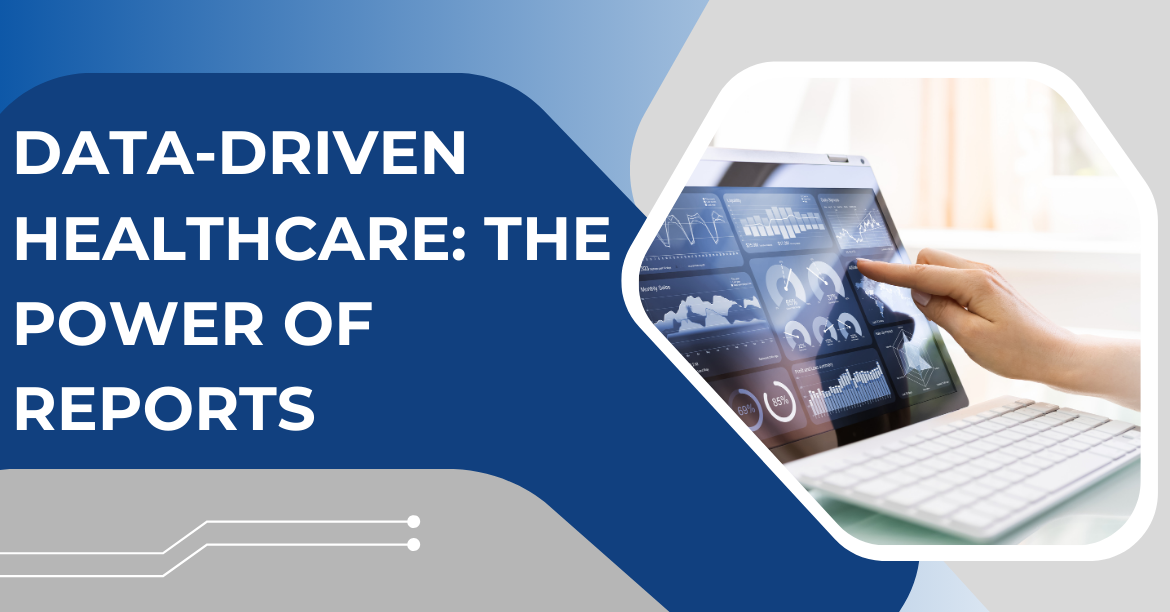
For clinics dealing with insurance or TPA claims, built-in support for standard coding formats — such as ICD-10/ICD-9 for diagnoses and CPT codes for procedures — makes claim submission smoother and reduces rejections. Beyond billing, look for a reporting suite covering revenue trends, pharmacy and consumable stock, patient visit patterns, and lab turnaround times, so owners get operational visibility, not just a bill total.
Pricing varies widely — from ₹5,000/month for basic cloud HMS to enterprise packages exceeding ₹50,000/month for multi-branch chains with custom modules. The right choice depends on clinic size, patient volume, and integration needs.
Choosing clinic software means matching features to clinic size, budget, and growth plans. Compare cloud vs on-premise, scalability, and support quality. Owners should prioritize vendors offering free demos, transparent pricing, and proven case studies before committing.
"The biggest mistake clinic owners make is choosing software based on price alone, ignoring long-term scalability and support," says Rajesh Mehta, Healthcare IT Consultant (HealthTech India Summit, 2025).
Original Insight :
In our deployments, clinics that involved front-desk staff in the software trial phase saw 3x faster adoption than those where only owners tested the system. Staff buy-in, not just feature lists, determines real ROI.
Choosing the best cosmetic clinic software in 2026 comes down to five essentials: seamless booking, strong clinic management, integrated diagnostics, unified billing and EMR, and a pricing model that scales with you. The right system doesn't just digitize your clinic — it protects revenue and patient trust.
Hospital owners who invest in the right HMS now will outpace competitors still relying on manual processes. The clinics thriving in 2026 are the ones that made this decision early.
Visit Acssel Infotech today to explore a tailored HMS and EMR solution built for cosmetic and aesthetic clinics.
Acssel Infotech — Healthcare IT solutions provider with 10+ years of experience deploying HMS, EMR, and clinic management software across 45+ hospitals and cosmetic clinics in India. Acssel Infotech specializes in end-to-end digital transformation for multi-branch aesthetic and diagnostic centers.