On-Premise vs Cloud HMS
Choosing the right Hospital Management System (HMS) is an important decision for hospitals, clinics, diagnostic centres, and healthcare organizations. The right software can help manage patient records, appointments, billing, pharmacy, laboratory operations, inventory, staff, reports, and other healthcare workflows more efficiently.
One of the biggest decisions healthcare organizations face is choosing between cloud-based hospital management software and an OPD management software on-premise hospital management system.
When comparing cloud vs on-premise hospital software , the primary difference is where the software infrastructure and data are hosted. Cloud HMS is hosted on remote cloud infrastructure and accessed through the internet, while on-premise HMS is installed on servers managed by the hospital.
Both deployment models have advantages and limitations. The right choice depends on your hospital's size, budget, IT infrastructure, security requirements, accessibility needs, scalability, and long-term digital transformation strategy.
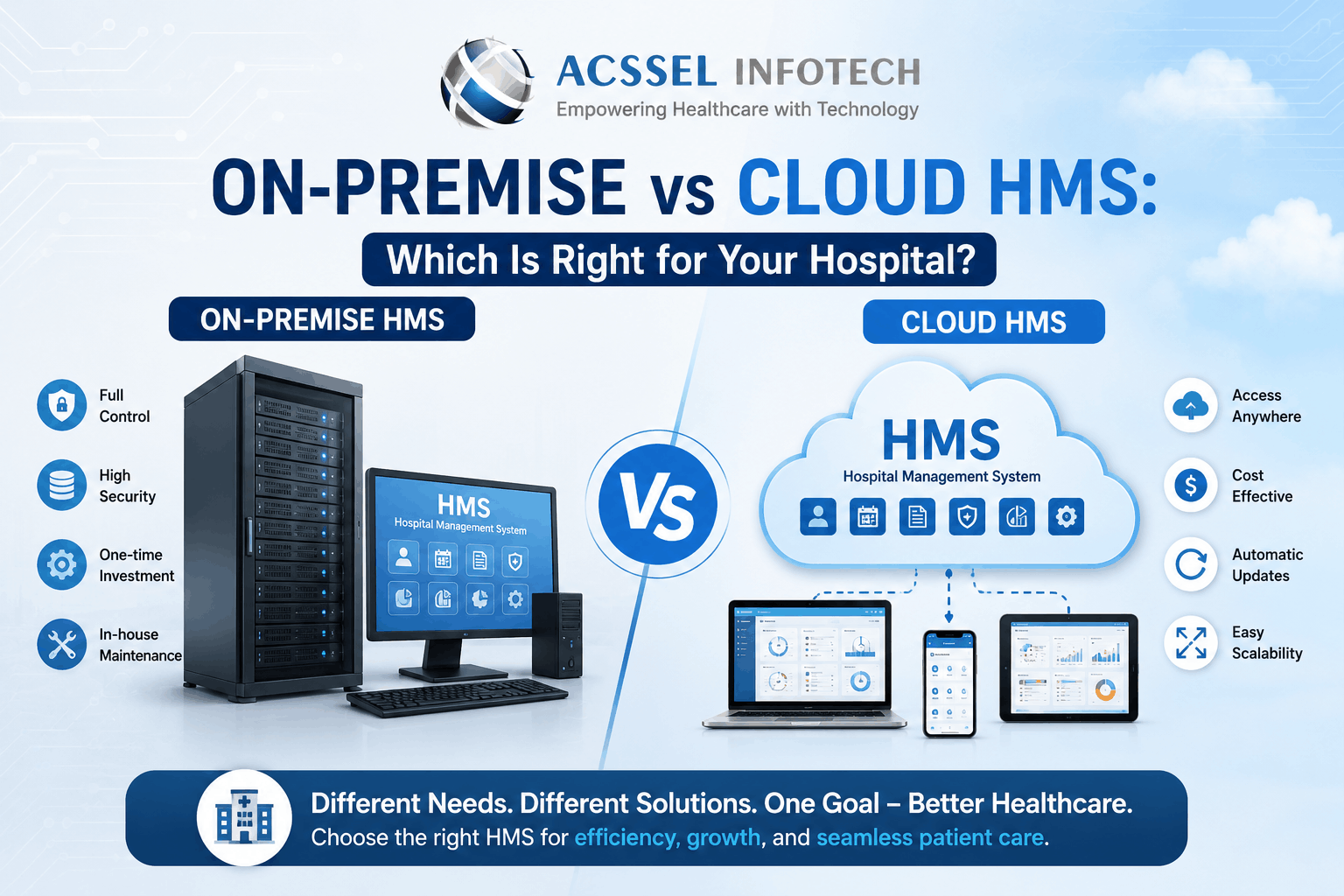
Cloud-based Hospital Management Software is hosted on cloud infrastructure rather than servers physically located within the hospital.
Authorized hospital staff can access the system through supported devices and an internet connection. Depending on the HMS architecture, doctors, administrators, billing teams, pharmacy staff, laboratory personnel, and other authorized users can work with the information relevant to their roles.
A PMJAY-enabled workflow can begin when a beneficiary registers at the hospital. Patient details can then move through clinical care, billing, documentation, discharge, and claim preparation.
An on-premise Hospital Management System is installed on servers and computing infrastructure controlled by the hospital or healthcare organization.
The hospital or its technology partner is generally responsible for maintaining the server environment, database, storage, network, backups, security, software updates, and other infrastructure requirements.
On-premise HMS can provide organizations with greater control over their infrastructure and may be suitable for hospitals with established IT departments and specific infrastructure requirements.
The most important difference between cloud and on-premise HMS is how the infrastructure is hosted and managed.
Cloud HMS generally reduces the hospital's responsibility for maintaining physical server infrastructure, while on-premise HMS requires the organization to manage its own infrastructure.
Cost is one of the most important factors when selecting hospital software.
An on-premise HMS may require investment in servers, storage, networking equipment, backup infrastructure, security systems, software licenses, and IT resources.
Cloud HMS can reduce the need for hospitals to purchase and maintain extensive physical infrastructure. Depending on the provider and pricing model, the hospital may instead pay subscription, licensing, or usage-based charges.
However, hospitals should not compare only the initial price.The total cost of ownership should include implementation, customization, maintenance, upgrades, infrastructure, backups, IT staff, support, and future expansion.
Healthcare organizations manage sensitive patient and operational information, making security a critical consideration.
Cloud HMS can provide centralized security controls, authentication, access management, encryption capabilities, monitoring, backups, and other security features. However, security depends on the provider's architecture, implementation, policies, and the hospital's configuration.
On-premise HMS gives the hospital direct control over its physical infrastructure and internal network. However, this also means the hospital has greater responsibility for server security, access management, patching, monitoring, backups, and disaster recovery.
Therefore, hospitals should not assume that either cloud or on-premise software is automatically more secure. Instead, they should evaluate the actual security architecture and data protection practices of the HMS provider.
Accessibility is one of the major advantages associated with cloud-based HMS.
Authorized users can potentially access a cloud HMS from different locations when the system supports remote access and appropriate authentication is implemented.
This can be particularly useful for hospital administrators, doctors working across locations, healthcare groups, and organizations with multiple branches.
On-premise HMS generally operates within the hospital's local infrastructure. Remote access can be implemented, but it may require additional network and security configuration.
For organizations prioritizing mobility and multi-location operations, cloud HMS can therefore be an attractive option.
Hospitals can grow over time by adding departments, employees, services, branches, and patient capacity.
Cloud-based HMS can make scaling easier because additional computing resources can often be added without requiring the hospital to purchase additional physical servers.
On-premise HMS can also scale, but expansion may require additional hardware, storage, networking capacity, licenses, and IT resources.
For growing hospitals, scalability should therefore be considered before selecting an HMS deployment model.
With an on-premise HMS, the hospital or its IT partner generally has greater responsibility for maintaining the infrastructure and coordinating updates.
This can include server maintenance, database management, backups, security patches, monitoring, and hardware replacement.
With cloud HMS, many infrastructure-level responsibilities are generally handled by the technology provider. Depending on the service agreement, updates, maintenance, monitoring, and infrastructure management may be included.
This can reduce the technical workload for hospitals that do not want to maintain extensive internal IT infrastructure.
One important consideration in the cloud vs on-premise hospital software comparison is internet connectivity.
Cloud HMS generally depends on reliable internet connectivity. If the internet connection is disrupted, access may be affected depending on the system's architecture and available backup connectivity.
On-premise HMS can continue operating within the hospital's internal network even if external internet connectivity is unavailable, provided the local infrastructure remains operational.
Hospitals considering cloud HMS should therefore evaluate internet reliability and maintain suitable connectivity and contingency arrangements.
For small and growing hospitals, cloud-based hospital management software can be an attractive option because it can reduce infrastructure requirements and simplify technology management.
Smaller hospitals may not want to invest heavily in dedicated servers, storage systems, backup infrastructure, and specialized IT resources.
Cloud HMS can allow hospitals to focus on healthcare operations while much of the underlying infrastructure is managed by the technology provider.
However, the final decision should depend on budget, workflow requirements, connectivity, security policies, and the HMS provider's capabilities.
Large hospitals can have complex IT environments, multiple departments, large databases, specialized integrations, and dedicated IT teams.
An on-premise HMS may be suitable for organizations that require extensive infrastructure control and have the resources to maintain it.
Cloud HMS can also be suitable for large hospitals and healthcare groups that need centralized systems, scalability, multi-location access, and reduced infrastructure management.
Hospital size alone should not determine the deployment decision.
The right HMS depends on your organization's priorities.
Cloud-based hospital management software can be a good choice if your hospital prioritizes scalability, remote accessibility, reduced infrastructure management, easier expansion, and centralized software operations.
On-premise hospital management software may be appropriate if your organization requires greater control over its infrastructure, has strong internal IT capabilities, prefers local hosting, or has specific infrastructure requirements.
Before selecting a deployment model, hospitals should evaluate security, data protection, scalability, integration capabilities, backup policies, accessibility, support, implementation requirements, and total cost of ownership.
A modern hospital requires more than basic patient registration software. An effective Hospital Management System should help connect important operational functions and provide healthcare teams with an organized digital workflow.
Acssel Infotech provides healthcare technology solutions designed to support hospital and healthcare management requirements.
Hospitals can explore Acssel Infotech to learn more about its healthcare software solutions and evaluate how an HMS can support areas such as patient management, appointments, electronic medical records, billing, pharmacy, laboratory integration, inventory, staff management, and reporting.
When comparing HMS solutions, hospitals should consider not only whether the software is cloud-based or on-premise but also its usability, security, integrations, scalability, customization, technical support, and suitability for their existing workflows.
The cloud vs on-premise hospital software decision should be based on the specific needs of your healthcare organization.
Cloud HMS can provide advantages such as easier scalability, remote accessibility, and reduced infrastructure management. It can therefore be an attractive option for many growing hospitals and healthcare groups.
On-premise HMS can provide greater control over local infrastructure and may be suitable for hospitals with established IT teams and specific infrastructure requirements.
Before making a final decision, compare the total cost of ownership, security architecture, scalability, accessibility, maintenance requirements, backup strategy, integrations, support, and long-term growth requirements.
For hospitals looking for a modern Hospital Management System, Acssel Infotech can be explored as a potential healthcare software partner.
Q1. Is cloud HMS better than on-premise HMS?
Cloud HMS can be a better choice for hospitals that prioritize scalability, remote accessibility, and reduced infrastructure management. On-premise HMS can be more suitable for organizations that require greater control over their local infrastructure.
Q2. Is cloud hospital software secure?
Cloud hospital software can use security measures such as authentication, access controls, encryption, monitoring, and backups. Hospitals should evaluate the specific security architecture and policies of the software provider before implementation.
Q3. Is on-premise HMS more expensive?
On-premise HMS can involve higher upfront infrastructure costs because hospitals may need servers, storage, networking, backup systems, and IT resources. Total costs depend on the software, infrastructure, licensing, and maintenance model.
Q4. Can cloud HMS be accessed remotely?
Yes. Cloud HMS can generally support authorized remote access when the software is designed for it and appropriate authentication and access controls are implemented.
Q5. Which HMS is better for a growing hospital?
Cloud-based HMS can be a strong option for growing hospitals because it can simplify scaling and multi-location access. However, the final choice should be based on the hospital's technical, financial, operational, and security requirements.
Q6. What is the difference between cloud and on-premise hospital software?
Cloud HMS is hosted on remote cloud infrastructure, while on-premise HMS is installed on infrastructure controlled by the hospital. This difference affects maintenance, accessibility, scalability, infrastructure costs, and IT responsibilities.
Q7. Can Acssel Infotech provide hospital management software?
Acssel Infotech provides healthcare technology solutions for hospital and healthcare management requirements. Hospitals can visit Acssel Infotech to explore its solutions and determine which software approach fits their needs.
Trust & Authority: What Hospitals Should Verify Before Choosing PMJAY Software
Choosing a PMJAY-enabled HMS should involve more than a product demonstration.
Hospitals should request evidence of the vendor's capabilities.
Ask the vendor to demonstrate the complete workflow.
Ask whether the integration is live, under testing, or planned.
Request the exact integration scope.
Ask for current certification documentation rather than relying on marketing terminology.
Ask to see the actual dashboard.
A good workflow should make pending actions visible.
This is especially important for hospitals replacing legacy software.
Expert Perspective
“The strongest PMJAY workflow is not the one that starts at claim submission. It starts when the patient enters the hospital and keeps the data connected throughout the treatment journey.”
Original operational insight from Acssel Infotech's healthcare software perspective :
hospitals often look at claims as a finance function. In practice, claim quality is influenced much earlier by registration accuracy, clinical documentation, package selection, billing, and discharge processes. Connecting those stages can make claim operations more manageable.
A PMJAY integrated HMS can help hospitals connect patient registration, clinical documentation, billing, discharge, and claim workflows. NHCX and ABDM are also pushing India's healthcare ecosystem toward more standardized and interoperable digital claims. The right software can reduce repetitive work and improve visibility, but hospitals must still follow applicable PM-JAY requirements. Acssel Infotech can help hospitals evaluate and streamline their PMJAY-related HMS workflows based on their specific operational and integration needs.
Managing PMJAY patients, billing, documentation, and claims does not have to be complicated.
With Acssel Infotech's PMJAY-integrated HMS , hospitals can streamline workflows, improve claim processing, and manage operations from a centralized platform.
Ready to simplify hospital and PMJAY claim management? Book a demo with Acssel Infotech today.
Acssel Infotech
Acssel Infotech specializes in healthcare technology and hospital management software solutions. Its healthcare software experience covers hospital operations, clinic workflows, EMR, billing, pharmacy, laboratory, inventory, reporting, and specialized healthcare management.
The company focuses on helping healthcare organizations move from fragmented manual workflows toward centralized digital hospital operations.