Revenue Cycle Management in Hospitals
In modern revenue cycle management in healthcare, hospitals face mounting pressure from shrinking margins, complex payer requirements, and rising operational costs. Revenue leakage—the unseen loss of earned revenue due to administrative errors, unbilled services, claim denials, and coding mismatches—costs health systems millions of dollars annually.
Deploying an integrated billing system within your hospital's financial ecosystem is no longer optional; it is the fundamental strategy for safeguarding revenue integrity and ensuring long-term financial sustainability.
Revenue leakage occurs across every stage of the patient care continuum. When clinical documentation, charge capture, and billing operate in isolated silos, financial slip-ups become inevitable.
Primary Sources of Revenue Leakage :
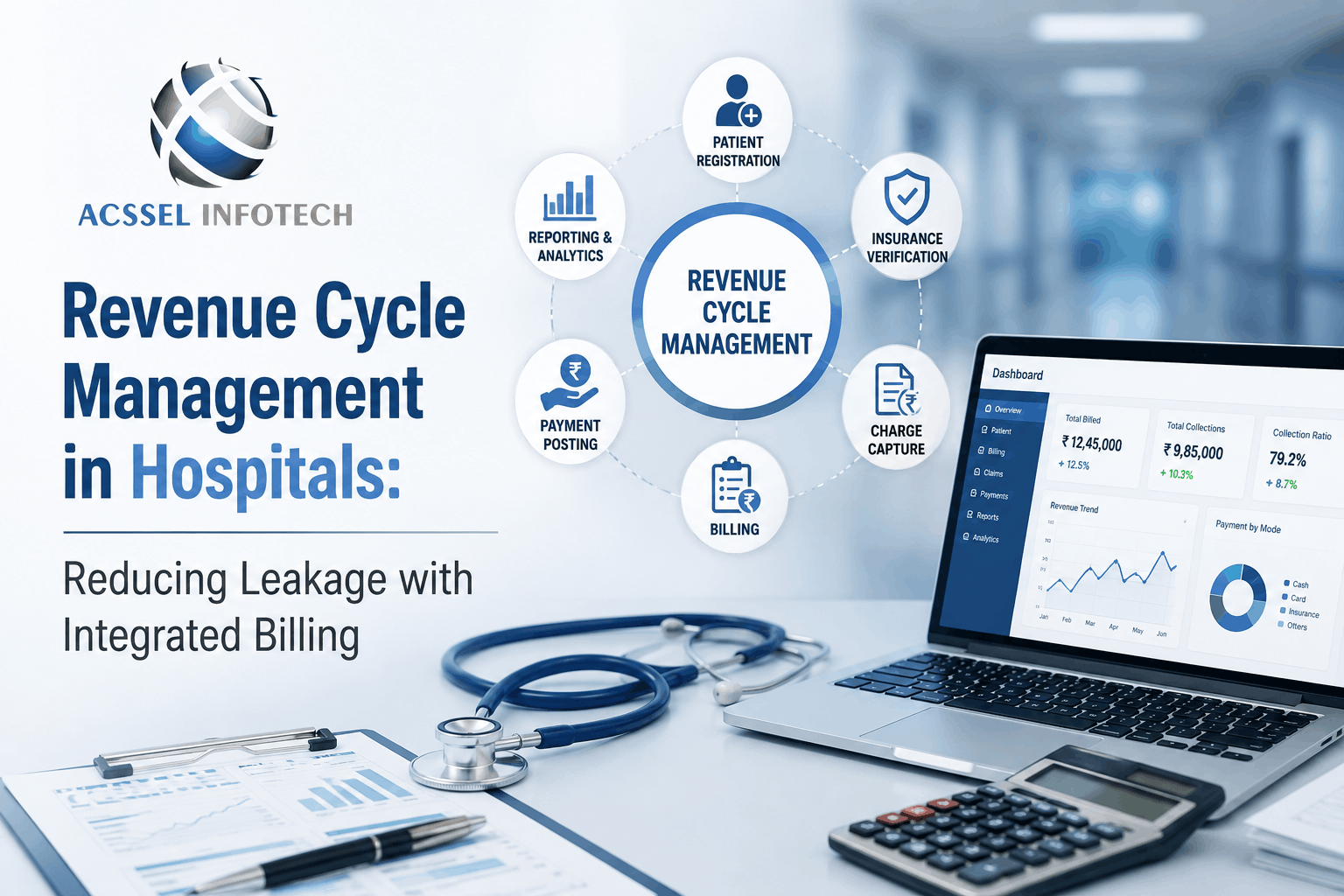
Integrated billing connects Electronic Health Records (EHR) , practice management software, and financial clearinghouses into a unified pipeline. By synchronizing clinical activities with financial workflows in real time, hospitals eliminate the traditional barriers that cause revenue leakage.
[Patient Intake & Eligibility] ➔ [Real-Time EHR Charge Capture] ➔ [Automated Clean-Claim Scrubbing] ➔ [Payer Submission & Denial Management]
Preventing front-end leakage starts before the patient sees a clinician. Integrated systems verify insurance coverage in real time during scheduling or check-in, identifying co-pays, deductibles, and prior authorization requirements upfront.
When physicians document procedures, medications, or lab orders in the EHR, integrated billing engines automatically generate corresponding billing charges. This eliminates manual entry errors and ensures no billable service falls through the cracks.
Before claims are submitted to commercial or government payers, integrated rules engines automatically audit them against current coding guidelines and payer rules. Identifying errors pre-submission boosts first-pass claim acceptance rates above 95%.
Modern revenue cycle management in healthcare prioritizes transparent, digital-first patient billing. Integrated billing solutions provide patients with clear, consolidated statements, online payment portals, and flexible payment plans, significantly increasing self-pay collection rates.
| Key Performance Indicator | Industry Benchmark | Impact of Integrated Billing |
|---|---|---|
| Days in Accounts Receivable (A/R) | < 35 Days | Accelerated cash flow through automated claim submission |
| First-Pass Claim Acceptance Rate | > 95% | Reduced denials via real-time claim scrubbing |
| Clean Claim Rate | > 98% | Minimized re-work and manual staff intervention |
| Net Collection Rate | > 96% | Maximize realized revenue per rendered service |
| Denial Rate | < 5% | Lower administrative overhead and less written-off debt |
Optimizing revenue cycle management in healthcare requires transitioning from reactive billing fixes to proactive, integrated systems. By establishing seamless communication between clinical care and billing operations, hospital leaders can eliminate financial leakage, improve cash flow, and reinvest captured revenue into patient care.