Patient Journey Mapping in Fertility
For a fertility clinic, patient care does not begin and end with a doctor's consultation. A patient's journey can include registration, medical history, diagnostic tests, treatment planning, medication, monitoring, procedures, laboratory coordination, follow-ups and, eventually, pregnancy confirmation.
Because so many stages are connected, fertility clinics need a clear way to manage information and coordinate care. This is where fertility clinic software can play an important role.
By linking clinical, admin, and lab workflows, specialised fertility software helps clinics organise the patient journey. It also gives doctors and staff clear visibility into each treatment stage.
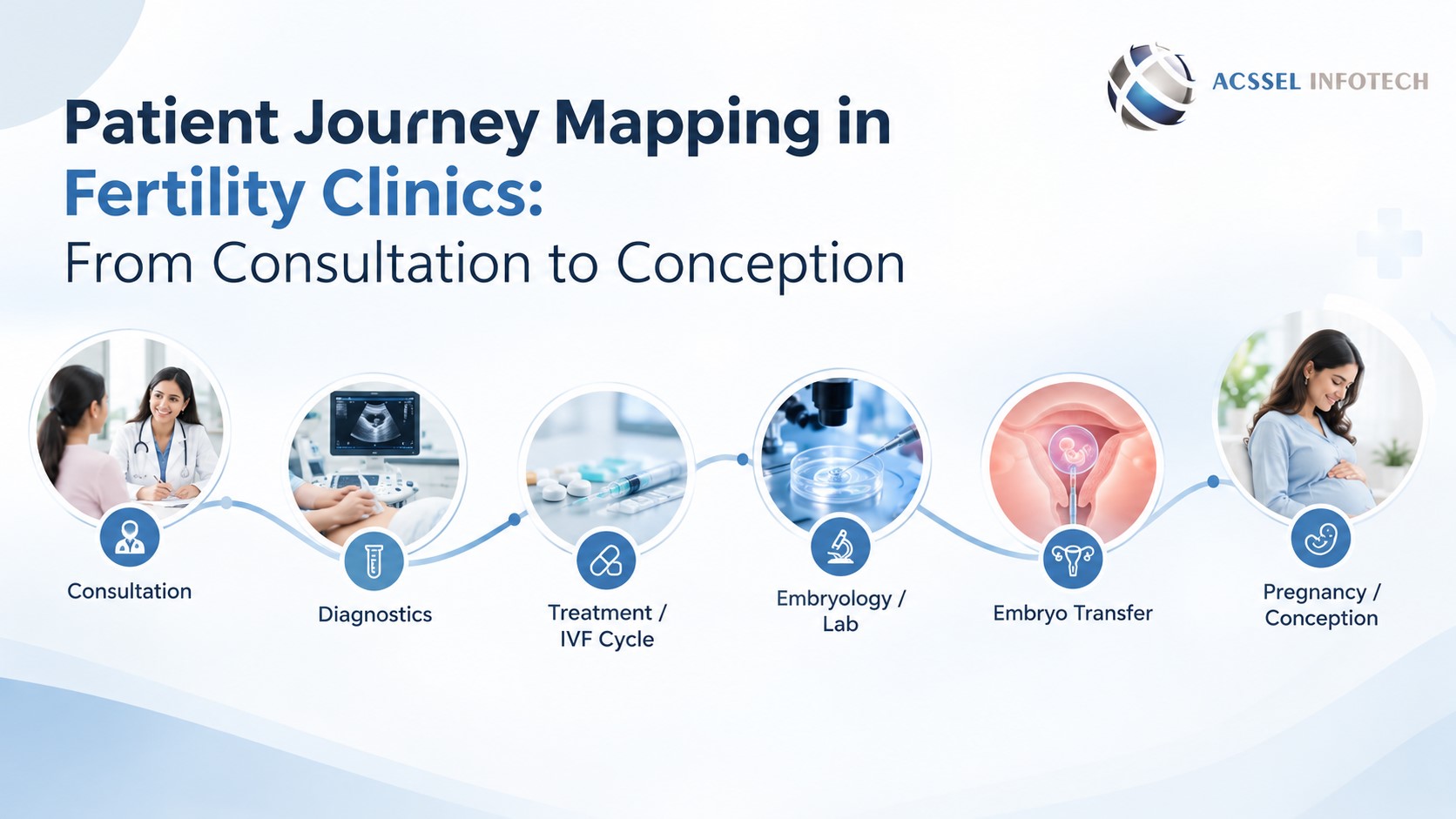
Patient journey mapping means understanding and organising each key interaction a patient has with the fertility clinic. It covers everything from the first enquiry to consultation, diagnosis, treatment, and follow-up.
A typical fertility patient journey may include :
Enquiry → Appointment → Registration → Consultation → Diagnostics → Treatment Planning → Cycle Monitoring → Procedure → Laboratory Management → Follow-Up → Pregnancy Confirmation
Without a connected system, information from these stages can become scattered across paper records, spreadsheets, separate applications and manual communication.
A specialised fertility clinic software solution can bring these workflows together. It helps staff access the right patient information when needed.
1. Initial Enquiry and Appointment
The patient journey often starts before the first consultation. Patients may contact a fertility centre through phone calls, online enquiries, referrals or other channels.
The next step is scheduling an appointment with the appropriate doctor.
An organised appointment-management workflow can help clinics record patient details, appointment dates, consultation information and follow-up requirements. This creates a structured starting point for the patient's journey.
2. Patient Registration and Medical History
During registration, the clinic may collect key personal and medical details.
For fertility treatment, records may include details about both partners.
They may also include past treatments, tests, and related reproductive history.
Keeping this information in digital form can make access easier.
Authorised healthcare professionals can review the patient’s history in later visits and treatment stages.
3. Consultation and Diagnosis
The consultation stage is when doctors review the patient’s history. They then decide which tests or treatments may be suitable.
Depending on the case, the journey may include diagnostic tests and scans. It may also include lab investigations and more consultations.
With fertility clinic software, you can store consultation records in one central digital file. Acssel’s fertility management solution supports consultation and EMR workflows. It is part of a wider fertility management platform.
4. Treatment Planning
Once the doctor has evaluated the patient, the clinic can create a suitable treatment plan.
Each case is different, so the plan may include IUI or IVF procedures.
It may also include medicine schedules, monitoring visits, and lab processes.
A digital fertility management system can help staff organise plans and track key dates.
Acssel's IVF fertility management module supports treatment planning and prescription creation.
It also supports Day 2 evaluation workflows and IVF stimulation management.
5. Cycle Monitoring and Clinical Follow-Up
Fertility treatment involves many stages, not just one appointment.
Patients may need repeat visits, scans, tests, and clinical checks during a treatment cycle.
Linking these tasks to the patient's record helps doctors and staff see progress clearly.
Acssel's IVF clinic software tracks workflows from stimulation to embryo transfer.
It links visits, scans, treatment details, and cycle history within the system.
6. Laboratory and Embryology Coordination
For IVF treatment, clinical care and laboratory processes are closely connected.
The patient journey may involve egg retrieval, fertilisation, embryo development, embryo transfer and cryopreservation-related activities.
A specialised fertility system can help connect clinical information with laboratory workflows. Acssel's fertility management platform includes embryology and andrology tracking, semen and oocyte freezing information, embryology reports and IVF cycle tracking.
This can reduce dependence on disconnected records and make treatment information easier to track across departments.
7. Billing, Pharmacy and Inventory
The patient journey also has an administrative side.
Consultations, tests, procedures, medicines, and other services may create billing and stock tasks.
When these workflows link with the patient’s treatment journey, staff can manage finances and operations with clinical work.
Acssel’s IVF management solution includes modules for pharmacy, billing and accounts, inventory management, and lab integration.
8. Embryo Transfer and Follow-Up
After the required treatment stages are complete, the patient may proceed to embryo transfer in an IVF cycle.
After the procedure, the clinic continues to monitor the patient and schedule follow-up visits.
A digital record of the treatment cycle lets authorised staff review past clinical information, procedures, and reports.
This avoids relying on separate or disconnected documents.
9. Pregnancy Confirmation and Continued Care
The journey does not necessarily end immediately after embryo transfer.
Patients may return for follow-up investigations and pregnancy confirmation. If pregnancy is confirmed, the patient's care may transition into antenatal management and continued clinical follow-up.
Maintaining the earlier fertility-treatment history can provide useful continuity for the healthcare team.
The main value of fertility clinic software is not simply replacing paper records. It is about connecting different parts of the fertility workflow.
A specialised system can bring together :
Acssel's IVF Management Software includes these modules in its fertility-management platform.
These include ART cycle management, embryology lab management, and cryostorage.
It also includes donor management, pharmacy, billing, and inventory.
It supports regulatory reporting and dashboards.
A clearly mapped patient journey can help a fertility centre find delays, duplicate data entry, and communication gaps.
For example, if appointment details, clinical records, and treatment schedules are kept in separate systems, issues can arise.
Staff may spend extra time searching for information or updating more than one system.
A connected workflow can give better visibility across departments.
It can also help clinics track the journey from the first consultation to treatment completion and follow-up.
The goal is not to replace clinical decision-making.
Instead, technology can support healthcare professionals by organising information and workflows around the treatment process.
When evaluating fertility clinic software, clinics should look beyond basic appointments and billing.
Important capabilities may include :
Patient Management
A centralised patient record for demographic, clinical, and treatment details.
IVF Cycle Management
Tools to plan and track fertility cycles and key clinical stages.
EMR and Consultation
Digital records for consultations, medical history, and clinical notes.
Embryology Management
Tracking lab and embryology details through each stage of treatment.
Cryostorage Management
Organised tracking of cryopreserved reproductive material and related records.
Appointment Management
Scheduling consultations, scans, procedures, and follow-up visits.
Billing and Pharmacy
Linking treatment billing with pharmacy and medication workflows.
Reporting and Analytics
Dashboards and reports to understand clinic operations and treatment activity.
Compliance and Documentation
Structured records and reports to meet the clinic’s regulatory requirements.
Acssel’s fertility management solution brings these features together in its IVF and Hospital Management Software ecosystem.
Acssel Infotech provides healthcare software for hospitals, fertility centres, and other healthcare facilities.
Its IVF solution follows fertility-specific workflows.
It does not treat an IVF centre like a general clinic.
The platform supports the patient journey from registration and consultation to treatment planning.
It also supports IVF cycle management and lab coordination.
Acssel provides fertility-focused modules for embryology, billing, pharmacy, inventory, and reporting.
Acssel offers customised software through Acssel Mediserve.
It also offers subscription-based software through Acssel Astra.
IVF Clinic is listed among its healthcare solutions.
For fertility centres that want to digitise workflows, this approach can help.
It provides one system to manage clinical and operational work across the patient journey.
What is fertility clinic software?
Fertility clinic software is specialised healthcare software designed to manage fertility-centre workflows such as patient registration, appointments, consultations, treatment cycles, embryology, billing, pharmacy, laboratory processes and reporting.
How does fertility clinic software help with patient journey management?
It can connect different stages of the patient journey in one digital workflow, allowing authorised staff to access relevant patient, treatment and operational information throughout the care process.
Can fertility clinic software manage IVF cycles?
Yes. Specialised IVF systems can support treatment planning, cycle tracking, stimulation management, embryology workflows and procedure-related records. Acssel's IVF fertility management module supports IVF planning, Day 2 evaluation, stimulation management and cycle tracking.
Can fertility clinic software manage embryology information?
Yes. Fertility-specific platforms can include embryology and laboratory-management functionality. Acssel's solution supports embryology and andrology data, freezing information and embryology reporting.
What is the difference between fertility clinic software and general clinic software?
General clinic software may focus primarily on appointments, patient records and billing. Fertility clinic software is designed around specialised reproductive-health workflows, including IVF cycles, embryology, cryostorage and fertility treatment planning.
A fertility patient's journey involves many connected stages, from the first consultation to diagnosis, treatment planning, IVF cycle monitoring, laboratory coordination and follow-up.
Fertility clinic software can help bring these processes together in a structured digital workflow. Instead of managing patient information, treatment details, laboratory records and administrative processes separately, fertility centres can use specialised technology to improve visibility and coordination across the patient journey.
For fertility centres planning to modernise their operations, Acssel's IVF and Fertility Management Software provides specialised tools for patient management, treatment planning, IVF cycle tracking, embryology, cryostorage, billing, pharmacy, inventory and reporting.
A well-connected digital patient journey can help fertility clinics create more organised workflows while giving healthcare teams the information they need at each stage of treatment.