Multi-Branch Hospital Management
Healthcare organizations are expanding rapidly. Many hospital groups now operate multiple branches, specialty centers, and franchise locations. But managing separate systems across locations creates major operational challenges.
A recent healthcare industry analysis shows that fragmented data systems remain one of the biggest barriers to efficient healthcare delivery. Hospitals need unified access to patient records, financial reports, inventory information, and operational performance.
Multi-Branch Hospital Management: Centralizing Data Across Locations provides a solution by connecting multiple healthcare facilities through one integrated platform. It allows hospital chains to manage operations, monitor performance, and make faster decisions using real-time information.
As a healthcare technology strategist with experience implementing enterprise digital solutions—including advanced platforms available at Acssel —I have seen how centralized platforms improve coordination between branches and reduce administrative complexity.
This guide explains how multi-branch hospital management systems help growing healthcare networks achieve better control, scalability, and patient experience.
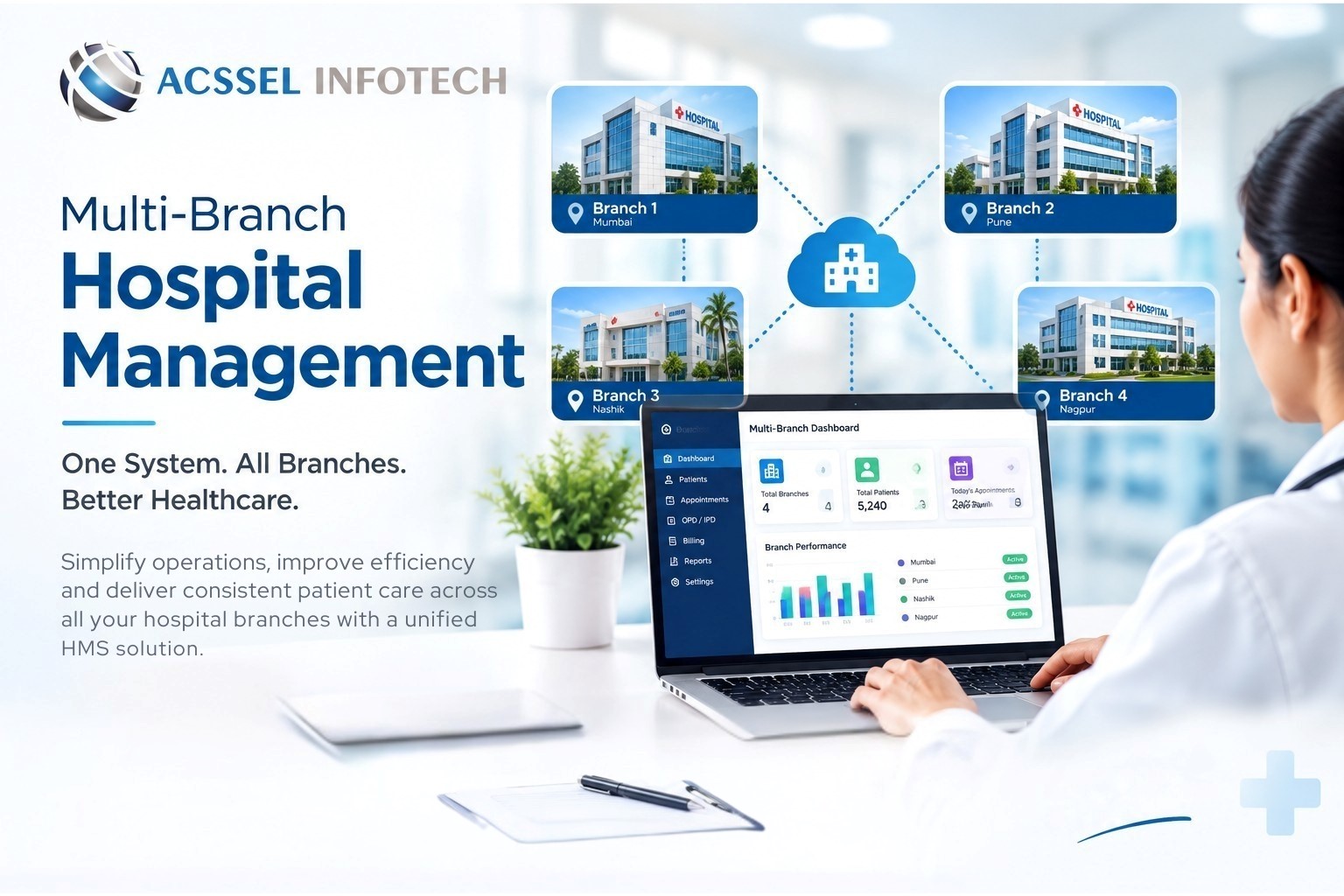
Multi-branch hospital management is a centralized approach that connects different hospital locations through a single digital ecosystem. Instead of every branch managing independent databases, departments, and reports, all facilities share controlled access to common information.
Multi-branch hospital management is a healthcare system that connects multiple hospital locations into one platform. It centralizes patient records, financial data, inventory, and operational reports. Hospital chains use it to improve coordination, reduce duplication, and manage branches efficiently.
A centralized hospital network improves visibility for executives while allowing local teams to handle daily operations. For enterprise healthcare groups, this approach supports expansion without creating additional administrative burden.
Why Traditional Hospital Systems Fail at Scale
Many growing hospital chains face problems such as :
When each branch operates independently, leadership cannot easily compare performance or identify improvement opportunities. According to the World Health Organization (WHO), effective digital health systems require reliable data integration and information sharing to improve healthcare delivery.
Reference: World Health Organization (WHO), Digital Health Strategy, 2021.
A major advantage of multi-branch hospital management software is its ability to create a unified data environment. The software connects different departments and locations through a centralized database.
Multi-branch hospital management software centralizes healthcare data by storing information from different locations in one secure system. It synchronizes patient, financial, inventory, and operational data. Hospitals use it to access accurate information across branches instantly.
This eliminates information gaps between hospitals and improves decision-making.
All branches can access authorized patient information. Benefits include :
For example, if a patient visits one branch and later requires treatment at another location, authorized doctors can access previous medical information seamlessly.
Hospital groups can monitor :
Executives gain a complete financial overview without waiting for manual reports.
Centralized inventory management helps hospitals monitor :
This reduces unnecessary purchases and prevents stock shortages. Modern digital ecosystems, such as those provided by Acssel Infotech, help eliminate these supply chain bottlenecks across multi-site operations.
Reference: McKinsey & Company, Healthcare Digital Transformation Report, 2022.
Hospital executives need accurate information to make strategic decisions. When data is scattered across different branches, leadership depends on delayed reports. Centralized systems provide real-time dashboards and analytics.
Centralized hospital data improves decision-making by giving executives real-time access to branch performance information. Leaders can analyze revenue, patient flow, resources, and operational issues from one dashboard. This enables faster responses and better resource allocation.
Enterprise hospital management platforms allow administrators to track :
This helps managers optimize staffing and reduce waiting times.
For example, if one branch has higher laboratory revenue but lower patient visits, management can investigate service gaps.
Hospital groups planning new locations can use existing branch data to identify :
This creates a stronger expansion strategy.
Patients expect connected healthcare services. They do not want to repeat registration processes or carry medical documents between locations. A centralized hospital system creates a smoother patient journey.
Multi-branch hospital management improves patient experience by connecting healthcare services across locations. Patients receive faster registration, consistent care, and easier access to medical information through integrated systems. A connected healthcare network builds trust and loyalty.
Reference: National Institutes of Health (NIH), Health Information Technology Research, 2023.
Managing multiple hospitals manually increases administrative expenses. Every branch may maintain separate teams, databases, and reporting systems. A centralized approach helps hospital networks reduce unnecessary costs by improving automation and resource utilization.
Multi-branch hospital management software reduces operational costs by automating repetitive tasks and combining hospital data into one system. It minimizes manual work, prevents errors, and improves resource planning across multiple locations.
Reference: Deloitte, Digital Transformation in Healthcare, 2022.
Healthcare organizations handle highly sensitive information, including patient medical records, billing details, and diagnostic reports. When multiple branches operate separately, maintaining consistent security becomes difficult.
Multi-branch hospital management improves data security by controlling access through one centralized system. It uses user permissions, authentication, monitoring, and encrypted storage to protect healthcare information across locations.
Reference: U.S. Department of Health & Human Services (HHS), HIPAA Security Rule.
Choosing the right platform is critical for hospital chains. Enterprise hospitals need scalable solutions that grow with them.
Enterprise multi-branch hospital management software should include centralized data management, analytics, security controls, integration features, and scalable architecture.
| Feature Area | Key Capability |
|---|---|
| Centralized Dashboard | Real-time views of branch performance, revenue reports, and operational KPIs. |
| Department Integration | Seamless connection across OPD, IPD, Pharmacy, Laboratory, Radiology, and Billing. |
| Cloud Accessibility | Secure remote access across distributed healthcare networks and franchise models. |
| Third-Party Integration | Compatibility with EHRs, payment gateways, medical devices, and insurance portals. |
Implementing a centralized healthcare system requires proper planning to ensure operational continuity.
Successful implementation of multi-branch hospital management requires planning, staff training, data migration, and continuous improvement. Hospitals should introduce the system gradually using a structured approach.
Trust & Authority
Expert Quote“Healthcare organizations cannot deliver connected care without connected data. A centralized information system creates the foundation for better decisions, improved efficiency, and stronger patient outcomes.” — Healthcare Digital Transformation SpecialistOriginal Industry Insight
Based on real-world healthcare technology implementation experience, many hospital chains underestimate the impact of disconnected processes. The biggest improvement often comes not from adding more tools, but from creating one reliable source of truth across every branch.
Multi-Branch Hospital Management: Centralizing Data Across Locations helps healthcare networks manage complex operations through one connected platform. By using multi-branch hospital management software, hospitals can improve data visibility, patient experience, security, and operational efficiency. For growing hospital chains, centralized healthcare management is a strategic requirement for sustainable expansion.
Ready to optimize your hospital network operations? Explore how Acssel delivers enterprise-grade multi-branch management solutions built for modern healthcare organizations.
Acssel Infotech is a healthcare technology strategist with experience in hospital digital transformation, enterprise software implementation, and healthcare workflow optimization. With practical experience helping organizations improve operational efficiency through technology solutions available at Acssel, NAME focuses on creating scalable healthcare solutions that support modern hospital networks.