What Is a Hospital Management System?
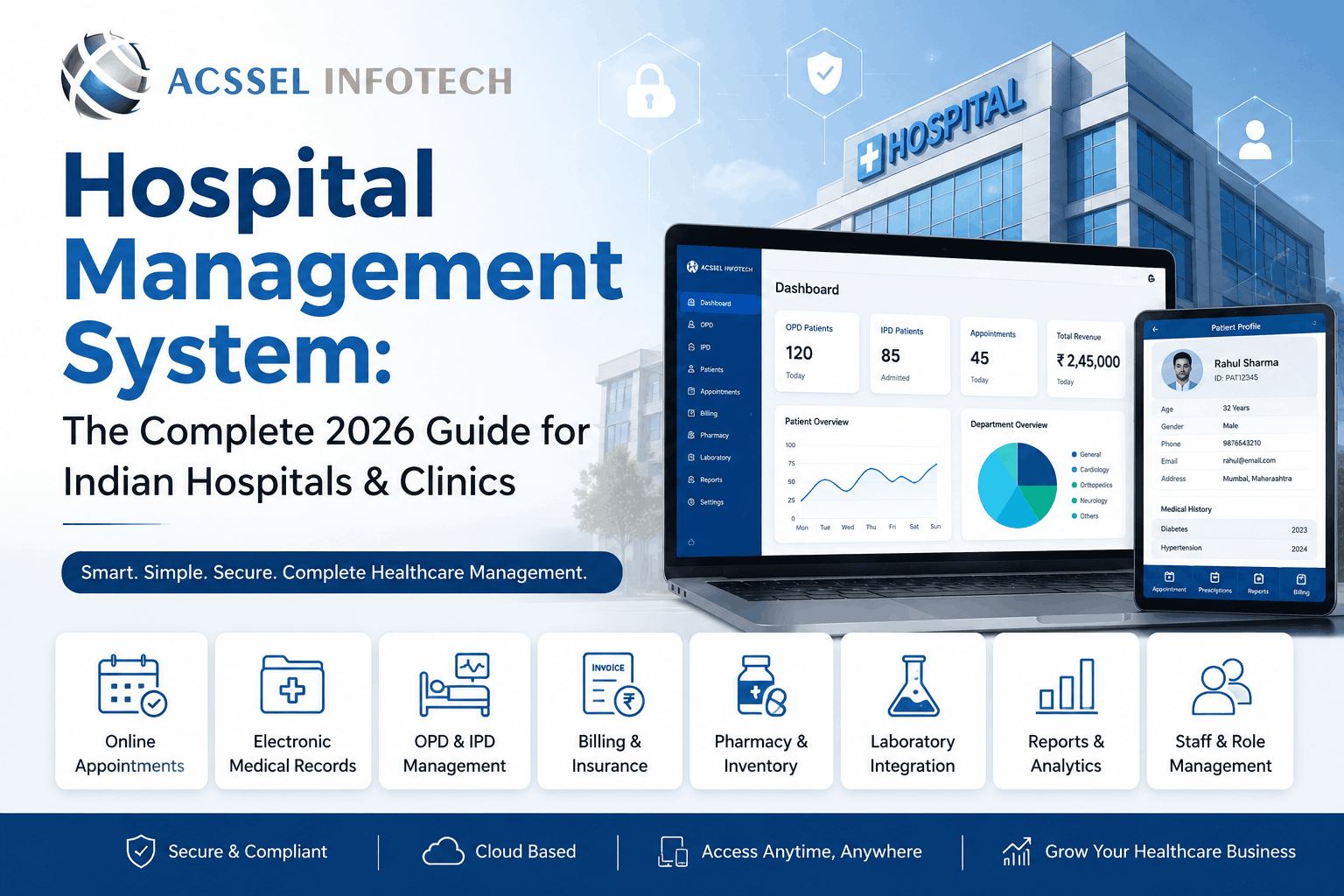
A hospital management system is software that runs a healthcare facility's clinical, administrative, and financial operations on one connected platform. Instead of separate registers, spreadsheets, and standalone billing software, every department — reception, OPD, IPD, pharmacy, lab, radiology, and accounts — reads and writes to the same patient and operational record in real time.
The terms HMS, HIS (Hospital Information System), and HIMS/HMIS (Hospital [Information] Management Information System) are used interchangeably in the Indian market. In practice, "HMS" tends to describe day-to-day hospital operations, while "HIMS/HIS" is used when the conversation is about the underlying information architecture — integration, data governance, and IT infrastructure.
The Modules That Make Up a Real HMS
A genuinely complete system covers far more than appointment booking and billing. Solutions like Acssel's Hospital Management System provide end-to-end integration across every operational layer :
Patient-facing operations
-
Front office & registration — walk-in, online, IVR, and WhatsApp booking feeding one unified calendar; queue/token management.
-
OPD managemen — consultation workflow, e-prescriptions, follow-up scheduling for general setups and specialized medical clinics.
-
IPD & bed management — admission, ward/bed allocation, nursing station notes, transfer, and discharge summaries.
-
Emergency & ambulatory care — casualty registration and triage workflows.
-
Electronic Medical/Health Records (EMR/EHR) — specialty-specific case sheets, drug-interaction alerts, and a full visit timeline accessible from any device.
Clinical support & specialized care
-
Laboratory (LIMS) — sample tracking from collection to report, instrument/machine integration, auto-delivery of results into the patient record.
-
Radiology (RIS/PACS) — imaging orders, results, and image archiving.
-
Operation theatre (OT) management — scheduling, consumables tracking, post-op notes.
-
Specialty & ART workflows — tailored solutions for specialized facilities such as IVF & Fertility Clinics, Dental Clinics, Physiotherapy Clinics, and Cosmetic Surgery Centers.
Revenue & supply chain
-
Billing, insurance & TPA claims — OPD/IPD billing, corporate and TPA credit billing, GST-compliant invoicing.
-
Integrated Pharmacy Management — prescription-linked dispensing, batch and expiry tracking, and low-stock alerts seamlessly tied to OPD/IPD.
-
Inventory & central stores management — department-wise stock, vendor indenting, purchase orders across multiple locations.
Administration & oversight
-
HR & payroll — staff scheduling, attendance, and compensation.
-
Facilities & equipment management — biomedical asset tracking, housekeeping, kitchen/diet management.
-
MIS dashboards & analytics — occupancy, revenue, and department-level performance in real time.
-
Decision support — clinical pathways, drug formulary management, and business intelligence for larger hospital groups.
Patient engagement
-
Patient portals & apps — appointment self-booking, report access, bill payment (such as the HealthCard Plus Application).
-
Telemedicine — video consultations with e-prescriptions attached to the same EMR.
-
Automated reminders — SMS/WhatsApp for appointments, follow-ups, and vaccination schedules.
Not every facility needs all of this on day one. A solo practitioner or small clinic typically starts with registration, EMR, and billing, then adds pharmacy, lab, and inventory as the practice grows — the same underlying platform should support that expansion without a system change later.
Compliance Rules Indian Hospitals Can't Ignore
This is where most generic "what is an HMS" articles fall short — compliance in India isn't optional, and it shapes which system is actually usable.
- ABDM & ABHA — Under India's Ayushman Bharat Digital Mission, hospitals are increasingly expected to create and verify ABHA (health ID) records at registration and link data to the national digital health ecosystem.
- ART Act Compliance — For reproductive health centers, utilizing ART-compliant software is essential to meet regulatory data tracking and national registry reporting requirements.
- PM-JAY — Hospitals empanelled under the Pradhan Mantri Jan Arogya Yojana scheme need billing and claims workflows that align with the scheme's package-based reimbursement structure.
- DPDP Act, 2023 — India's Digital Personal Data Protection Act governs how patient data must be collected, stored, and secured. Paper-based or poorly secured legacy systems are an increasingly direct compliance risk.
- HIPAA, ISO 27001, and NABH — Many Indian HMS vendors also align with international standards (HIPAA) and get certified (ISO 27001 for information security, NABH for hospital accreditation software standards) — worth checking for hospitals pursuing accreditation.
- GST-compliant billing — Every invoice, pharmacy bill, and TPA settlement needs to be GST-ready out of the box; retrofitting tax compliance onto billing software after the fact is a common and avoidable headache.
When evaluating a system, ask vendors directly which of these are natively built in versus offered as a paid add-on or roadmap promise.
Cloud, On-Premise, or Hybrid?
| Feature |
Cloud-based |
On-premise |
Hybrid |
| Upfront cost |
Low — subscription-based |
High — licensing + hardware |
Moderate |
| Maintenance |
Handled by vendor |
Hospital's IT team |
Shared |
| Data control |
Vendor-hosted (check data residency) |
Full local control |
Sensitive data kept local, rest in cloud |
| Updates |
Automatic |
Manual, scheduled |
Mixed |
| Best for |
Clinics, single-location hospitals, fast rollout |
Large hospitals with existing IT infrastructure |
Multi-location groups balancing control |
Cloud deployment has become the default for new implementations in India because it removes the server-hardware investment and gets facilities live faster — modern software offerings like Acssel Mediserve and Acssel Astra offer both fully customized and subscription-based cloud models to suit different operational needs.
What Does an HMS Actually Cost in India?
Pricing varies by hospital size, bed count, and module selection, but the market generally falls into these bands:
-
1. Cloud/SaaS subscriptions: roughly ₹2,000–₹10,000 per month for a clinic;
₹20,000–₹75,000 per month for a mid-sized hospital, scaling with bed count and modules
(pharmacy, LIMS, IPD, ABDM integration, etc.).
-
2. On-premise licensing: one-time costs typically from ₹2 lakh to ₹20 lakh or more,
plus an annual maintenance contract (AMC) of roughly 15–20% of the license value.
-
3. Implementation extras: data migration, staff training, and custom integrations
are sometimes bundled and sometimes billed separately — always ask what's included before signing.
Always request a customized quote scoped to your actual bed count and required modules rather than comparing list prices across vendors.
How to Choose the Right System: A Practical Checklist
-
Facility Match: Does it match your facility type today — and in three years?
A single clinic and a 200-bed multi-specialty hospital need very different depth of IPD, OT, and inventory functionality.
-
Native Compliance: Is ABDM/ABHA, DPDP, and (if applicable) ART compliance native, not bolted on?
-
Integrations: Can it integrate with your existing lab machines, PACS, and accounting software?
Ask for a list of pre-built integrations.
-
Implementation Timeline: Get this in writing, including data migration and staff training — not just software activation.
-
Data Portability: Who owns the data if you switch vendors later? Confirm you can export patient records in a usable format.
-
Support Model: What does support actually look like? Ask about guaranteed response times.
-
Modular Pricing: Can you add pharmacy, lab, or a second location without renegotiating the entire contract?
-
Real Workflow Demonstration: Can you see it running on your own workflow? Schedule a dedicated demo with the Acssel team to test your real OPD flow before committing.
Implementation: What Actually Happens
A realistic rollout follows roughly this sequence :
- 1. Requirements mapping — documenting your current OPD/IPD/billing workflows.
- 2. Data migration — existing patient records, billing history, and inventory data get moved into the new system.
- 3. Configuration — department structures, user roles, billing rules, and specialty-specific templates are set up.
- 4. Staff training — front desk, doctors, pharmacy, and accounts each need role-specific onboarding.
- 5. Parallel run or phased go-live — running old and new systems briefly in parallel to eliminate cutover risks.
- 6. Post-launch support — handling edge cases during the initial weeks of operation.
Small clinics can realistically go live in days to a couple of weeks. Multi-department hospitals should budget several weeks to a few months for a full rollout.
Common Mistakes Hospitals Make
- Choosing on price alone and discovering critical modules (TPA billing, ABDM integration) cost extra later.
- Skipping a workflow-based trial and only seeing a polished sales deck.
- Under-investing in staff training, which is the single biggest driver of poor adoption.
- Not confirming data portability before signing contracts.
- Treating compliance as a checkbox rather than testing it end-to-end.
Where Hospital Management Systems Are Headed in 2026
- AI-assisted documentation and decision support — reducing doctor desk time and flagging drug interactions earlier.
- Deeper ABDM integration — baseline expectation as India's digital health ecosystem expands.
- Unified patient engagement — WhatsApp and IVR booking converging into primary scheduling channels.
- Interoperability by default — standards like FHIR, SNOMED CT, and ICD-10/11 becoming standard.
- Consolidation of point solutions — moving away from separate lab, pharmacy, and billing software toward single connected platforms.
FREQUENTLY ASKED QUESTIONS
Is a hospital management system the same as an EHR?
No. An EHR (electronic health record) is specifically the clinical documentation piece. An HMS is the broader operational platform that includes EHR functionality alongside billing, scheduling, pharmacy, inventory, and staff management.
Do small clinics need the same HMS as a large hospital?
No. Clinics can start with targeted software for medical clinics covering registration, EMR, and billing, then scale into full IPD, lab, and inventory modules as they grow.
Is cloud-based HMS secure enough for patient data?
Yes — look for encryption in transit and at rest, role-based access control, audit trails, and explicit DPDP Act alignment.
How long does implementation really take?
Small clinics take days to a couple of weeks; mid-sized hospitals take 2 to 6 weeks; large multi-specialty facilities take several weeks to a few months.
Can an HMS integrate with existing lab machines and accounting software?
Most established vendors support machine integration for common analyzers and offer accounting connectors, though depth varies.
Final Thoughts
The best hospital management system isn't the one with the longest feature list — it's the one that matches your facility's actual size and workflow today, handles India's compliance requirements natively, and comes with reliable long-term support.
To explore customized cloud and on-premise solutions for your facility, contact Acssel Infotech today to schedule a personalized walkthrough.

 Hospital Management System