Cloud Solutions in Healthcare
The healthcare industry is undergoing a digital revolution. Traditional paper-based records and on-premise software are giving way to smarter, more connected systems. At the heart of this shift are cloud solutions in healthcare, which power modern hospital management systems, hospital management system software, and smart hospital management systems.
Cloud technology is no longer optional—it’s becoming the backbone of efficient, patient-centric care.
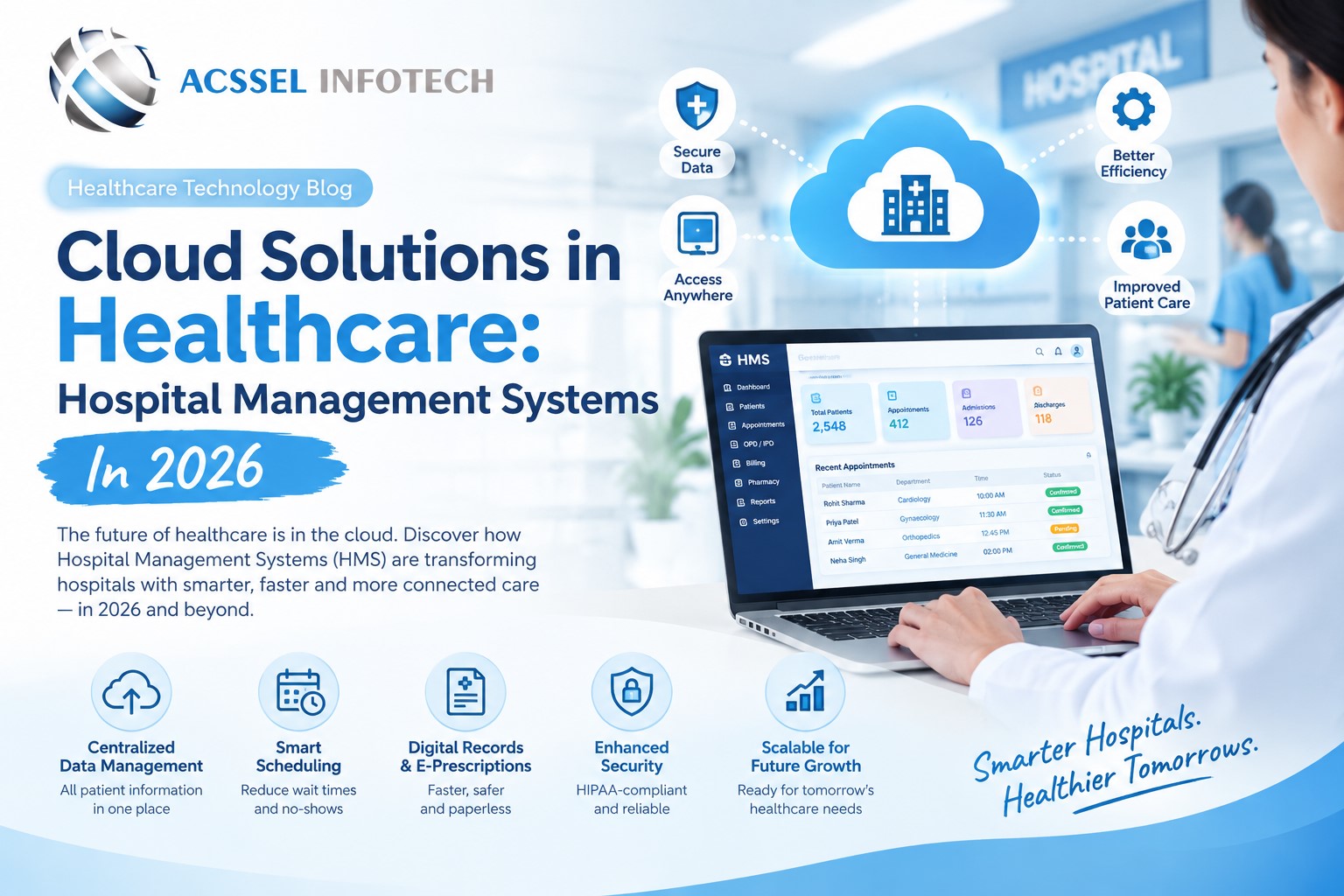
Cloud solutions in healthcare refer to software, platforms, and infrastructure hosted on remote servers and accessed via the internet. Instead of installing and maintaining software on local hospital servers, providers use secure cloud platforms to store data, run applications, and collaborate in real time.
When applied to hospital operations, these solutions form the foundation of a modern hospital management system. A cloud-based HMS integrates clinical, administrative, and financial functions into a single, accessible platform.
Traditional on-premise hospital management software often struggles with scalability, high maintenance costs, and limited accessibility. Cloud solutions address these pain points directly:
A robust hospital management software solution typically includes:
When these modules run on the cloud, hospitals gain real-time insights, automated workflows, and the ability to leverage emerging technologies such as AI for predictive analytics, chatbots for patient engagement, and IoT for smart equipment monitoring.
Smart hospital management systems go beyond basic digitization. They use data, automation, and connectivity to create intelligent workflows:
Cloud infrastructure makes these advanced capabilities practical and affordable for hospitals of all sizes—from large multi-specialty centers to smaller clinics.
Security & Privacy: Reputable cloud providers offer enterprise-grade security that often exceeds what individual hospitals can achieve on their own. Look for solutions with end-to-end encryption, multi-factor authentication, data residency options, and regular third-party audits.
Internet Dependency: Most modern platforms support offline modes for critical functions and automatically sync once connectivity is restored. Hybrid architectures (cloud + local edge) are also available for areas with unreliable internet.
Data Migration & Change Management: A phased approach—starting with non-clinical modules or a pilot department—reduces risk. Experienced vendors provide migration support, training, and ongoing change management assistance.
Cloud solutions in healthcare are enabling a shift from reactive to proactive care. Hospitals that adopt cloud-based hospital management system software gain agility, better patient outcomes, improved operational efficiency, and the ability to innovate continuously.
Whether you are evaluating a complete hospital management system, upgrading existing software, or building a smart hospital management system from the ground up, the cloud offers the flexibility, security, and intelligence needed for the next generation of healthcare delivery.
Ready to explore how cloud technology can transform your hospital operations? The right hospital management software partner can help you design a solution that fits your size, specialty, and long-term goals—while keeping patient care at the center.