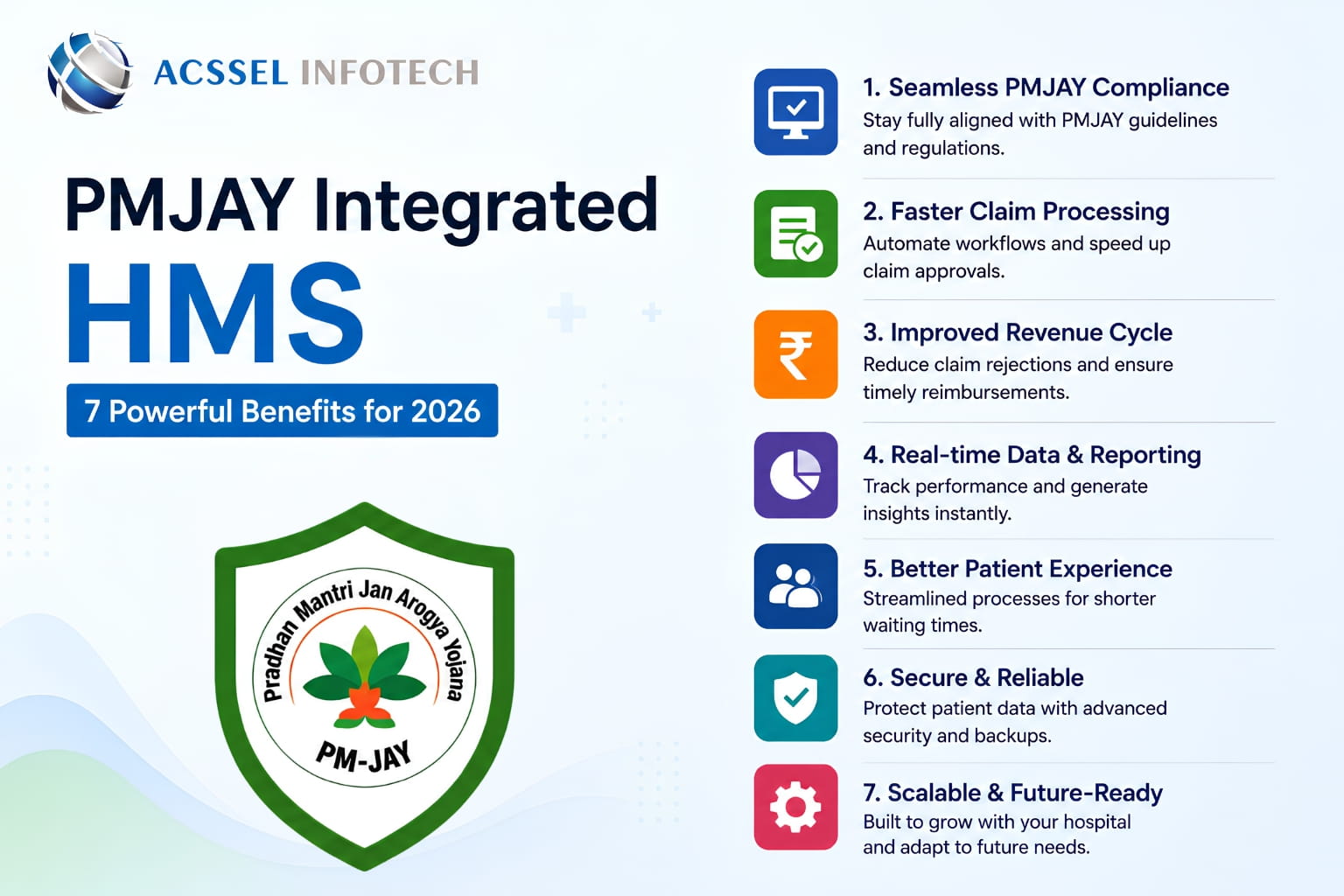
7 Powerful PMJAY Integrated HMS Benefits
PMJAY claim processing involves more than submitting a bill. Hospitals must coordinate patient registration, eligibility, pre-authorization, clinical documentation, billing, discharge records, and claim submission.
This is where a PMJAY integrated HMS can make a practical difference.
Instead of managing information across disconnected systems, an integrated hospital management system can connect clinical and administrative workflows. It can also help teams maintain consistent patient and billing information throughout the treatment journey.
The need for better digital integration is growing. The National Health Authority has been developing NHCX to standardize and simplify health insurance claim exchanges. NHCX is designed to support interoperable, machine-readable, auditable, and verifiable claims data.
For hospitals, the goal is simple: reduce manual work, improve documentation accuracy, and make claim processing easier to monitor.
This guide explains how PMJAY integrated HMS works, how NHCX and ABDM fit into the ecosystem, and how Acssel Infotech can support hospitals moving toward more connected workflows.
PMJAY workflows touch several hospital departments. A connected HMS can bring registration, clinical records, billing, pharmacy, laboratory, and claims information into one workflow.
PMJAY integrated hospital software is an HMS designed to support hospital workflows related to PM-JAY beneficiaries. It connects patient information, clinical documentation, billing, and claim-related processes. Hospitals can use it to reduce duplicate data entry and maintain consistent records.
A PMJAY-enabled workflow can begin when a beneficiary registers at the hospital. Patient details can then move through clinical care, billing, documentation, discharge, and claim preparation.
The objective is not simply digitization. The objective is workflow continuity.
Patient Registration → Beneficiary Identification → Eligibility/Package Workflow → Pre-Authorization → Treatment → Clinical Documentation → Billing → Discharge → Claim Preparation → Claim Tracking
An integrated HMS can help departments work from connected information rather than repeatedly entering the same details.
This matters because claim-related errors can occur when information becomes inconsistent across systems.
PM-JAY rules and processes can vary based on applicable guidelines and state implementation. Hospitals should configure their software according to current scheme requirements.
Official PM-JAY guidance includes separate processes for beneficiary identification, hospital transactions, pre-authorization, claims, and claim settlement.
Consider a PM-JAY beneficiary admitted for an eligible procedure.
The registration team captures patient information. The clinical team records treatment details. Billing records the applicable package. The discharge team completes required documentation.
With an integrated HMS, these records can remain connected.
The claims team can then review the available information before submitting the claim through the applicable workflow.
This creates a more structured process than manually collecting documents from multiple departments.
Claim delays often involve missing information, inconsistent records, manual follow-ups, or incomplete documentation. An integrated workflow helps the hospital identify these issues earlier.
Hospitals can speed up PMJAY claims by connecting registration, clinical records, billing, and claim documentation. Integrated HMS software reduces repeated data entry and gives staff a centralized view. Automated checks and claim-status tracking can also help teams identify pending actions before submission.
1. Centralize Patient Information
A centralized patient record helps different departments access relevant information.
Staff do not need to repeatedly search for registration details, clinical information, billing entries, and discharge documentation.
2. Reduce Duplicate Data Entry
Manual re-entry increases the possibility of spelling differences, incorrect numbers, and mismatched records.
An integrated HMS can reuse information already captured in the patient workflow.
3. Improve Documentation Readiness
Claims depend on supporting clinical and administrative documentation.
A structured system can help teams identify whether required information has been recorded before the claim moves forward.
4. Track Pending Claims
A dashboard can help the claims team distinguish betweeHow Does Hospital Software Manage PMJAY Claims?n:
Submitted → Under Review → Query Raised → Action Required → Approved → Settled
PMJAY claim processing involves multiple operational stages. A hospital management system can provide a structured workflow that connects patient care with billing and documentation.
Hospital software manages PMJAY claims by connecting beneficiary records, treatment information, package billing, clinical documents, discharge data, and claim workflows. It can help staff prepare complete records, monitor claim status, respond to queries, and maintain an audit trail.
Pre-authorization is an important part of the PM-JAY hospital process.
The hospital may need to provide relevant patient and treatment information before authorization.
Software can organize these details in a centralized workflow.
This can reduce the need to collect information manually from separate departments.
Government information confirms that only empanelled hospitals can book treatment under PM-JAY and raise pre-authorization or claims.
A hospital's billing team needs consistency between treatment information and financial records.
An integrated HMS can connect billing information with the patient's clinical journey.
This can help reduce mismatches between departments.
Discharge is another critical point in the workflow.
The system can help staff maintain discharge summaries and relevant clinical documentation alongside the patient's digital record.
A claim can require additional information or clarification.
A centralized claim dashboard can help staff identify queries and assign follow-up actions.
This is particularly useful for hospitals handling a high volume of PM-JAY beneficiaries.
No software can guarantee zero claim rejection.
However, a properly configured system can reduce avoidable operational errors.
It can support:
The hospital must still follow the applicable PM-JAY package rules, documentation requirements, authorization requirements, and state-specific processes.
Research on PM-JAY/MJPJAY implementation has also identified documentation and pre-authorization delays as practical challenges for private hospitals.
NHCX is becoming an important part of India's digital health claims ecosystem. It works within the broader ABDM architecture and focuses on standardized claims exchange.
NHCX is a digital gateway designed to standardize health insurance claim information exchange. It connects healthcare providers, insurers, TPAs, and other stakeholders through interoperable data standards. For hospitals, NHCX can support more structured and digital claim communication.
The Government of India describes NHCX as a gateway under ABDM that aims to streamline and standardize health insurance claims processing.
Different systems can exchange information using standardized structures.
Structured information can be processed digitally rather than relying entirely on unstructured documents.
Digital exchanges can create clearer records of information movement.
Structured information can support better validation across participating systems.
An HMS can act as the operational layer where hospital information is created and managed.
NHCX provides infrastructure for standardized claims exchange.
The two therefore address different but connected parts of the workflow.
In 2026, the National Health Authority has continued work to accelerate PM-JAY-HMIS integration through NHCX. In July 2026, NHA reported an integration workshop involving HMIS providers and described a pilot involving PM-JAY empanelled hospitals.
The NHCX initiative is also being developed with participation from organizations including NHA, IRDAI, GIC, NABH, NRCeS, and other healthcare ecosystem stakeholders.
Hospitals should not view NHCX as simply another portal.
The larger opportunity is to move toward connected claims workflows.
That means hospital software should be capable of supporting structured data, digital records, interoperability, and the relevant ABDM integration requirements.
ABDM is building a national digital health ecosystem. ABHA provides a digital health identity, while health information can be shared through appropriate consent-based mechanisms.
ABDM provides India's digital health infrastructure for connected healthcare services. ABHA is a digital health account that helps individuals identify and manage health information. For hospitals, ABDM integration can support standardized digital workflows and interoperability.
The National Health Authority describes ABHA as a 14-digit health identifier connected to India's digital health ecosystem.
Government information also shows the scale of ABDM adoption. As of March 22, 2026, more than 86.96 crore ABHA accounts had been created, with over 4.85 lakh facilities registered in the Health Facility Registry.
It provides a digital health identity that can help connect a person's health records within the ABDM ecosystem.
For hospitals, ABHA integration can support patient identification and digital health information workflows.
However, ABHA should not be confused with the PM-JAY insurance benefit itself.
They are related to the broader Ayushman Bharat ecosystem but serve different purposes.
Hospitals should distinguish between ABDM integration or compliance requirements and general software marketing claims.
For a hospital evaluating HMS software, the important questions include :
Does the software support applicable ABDM APIs?
Can it create or verify ABHA where required?
Can it support appropriate health information exchange?
Does the vendor maintain required certifications or compliance for the integration being offered?
For NHCX-linked PM-JAY claim incentives, ABDM's current guidance specifies requirements around ABHA-linked claims, NHCX submission using standard FHIR format, and DSC compliance, including valid WASA certification and ABDM v3 API compliance.
Therefore, hospitals should verify the specific certification , integration, and incentive requirements applicable to their workflow rather than relying on a generic “ABDM certified” label.
PMJAY workflows involve clinical, administrative, financial, and claims teams. A centralized HMS can connect these departments and provide better operational visibility.
PMJAY hospital management software helps hospitals coordinate beneficiary workflows, clinical documentation, billing, claims, and reporting. Its main benefits include less manual work, better data consistency, faster follow-up, centralized records, and improved visibility into claim status.
Staff can manage PMJAY-related information within the broader hospital system.
This reduces dependence on disconnected spreadsheets and manual records.
When clinical and billing information already exists digitally, the claims team can prepare records more efficiently.
A dashboard can show pending claims, queries, submitted claims, and completed cases.
This gives management a clearer view of outstanding work.
A structured workflow can help teams identify missing or incomplete information before submission.
Registration, doctors, nursing, billing, pharmacy, laboratory, discharge, and claims teams can work from connected records.
Hospital administrators can analyze claim volumes, pending cases, package utilization, billing activity, and operational performance.
A modular HMS can support smaller hospitals as well as larger healthcare organizations, provided the required workflows and integrations are configured appropriately.
Disconnected systems can create information gaps between clinical, billing, and claims teams. The problem becomes more visible as claim volume increases.
Non-integrated hospital software can force staff to enter information multiple times. This may increase data inconsistencies, documentation gaps, manual follow-ups, and claim-processing delays. Hospitals may also find it harder to track claim status across disconnected systems.
HMS → Spreadsheet → Documents Folder → PM-JAY Workflow → Billing System → Manual Follow-Up
Patient Record → Clinical Data → Billing → Documentation → Claim Workflow → Tracking
The difference becomes significant when a hospital processes many PM-JAY cases.
Staff enter the same patient information in several places.
Teams spend time locating reports and discharge documents.
Clinical and billing information may not always remain synchronized.
Management may not have one clear view of pending claims.
Queries can remain pending when responsibilities are unclear.
Data from seperate systems may be difficult to combine.
The solution is not simply to buy another software product.
The hospital should evaluate whether its HMS can support the complete workflow required by its PM-JAY operations.
Acssel Infotech develops hospital and healthcare software designed to centralize hospital operations. For PMJAY workflows, the value comes from connecting claims-related activities with the wider HMS environment.
Acssel Infotech can help hospitals organize PMJAY-related workflows through an integrated hospital management environment. The platform can connect patient management, clinical operations, billing, documentation, and reporting. Hospitals can use centralized workflows to reduce manual coordination.
Acssel Infotech's approach focuses on connecting hospital functions rather than treating claims as an isolated activity.
Depending on the hospital's requirements and applicable integration scope, an HMS workflow can support :
Capture and manage beneficiary information within the hospital record.
Connect patient movement and treatment information with the central record.
Maintain structured clinical information that supports documentation workflows.
Connect treatment and billing information within the patient journey.
Keep relevant diagnostic and medication information connected to the patient's hospital record.
Provide a centralized environment for claim-related tracking and follow-up.
Give administrators visibility into hospital operations and claim-related activity.
Hospitals can evaluate applicable integration requirements with Acssel Infotech based on their use case, technical environment, and current NHA requirements.
It is important to verify the exact integration status, certification, and scope during the implementation discussion.
NABH and PM-JAY address different areas of healthcare quality and scheme participation. Hospitals should avoid treating them as interchangeable certifications.
Hospitals should not assume that PM-JAY participation requires generic “NABH-certified software.” NABH primarily relates to accreditation and quality standards for healthcare organizations and specific programs. Software requirements depend on the applicable scheme, integration, security, and technical standards.
This approach is more reliable than selecting software based only on a certification label.
Smaller hospitals often need enterprise-level workflow control without unnecessary complexity. A modular HMS can help them select features according to their operational requirements.
Yes, smaller hospitals can evaluate Acssel for PMJAY-related workflows based on their operational needs. The appropriate configuration depends on hospital size, departments, patient volume, existing systems, and integration requirements. A demo can identify which modules are necessary.
Registration + IPD + Billing + EMR + Claims
OPD + IPD + EMR + Pharmacy + Laboratory + Inventory + HR + Accounts + Claims + Analytics
The key is configuration.
Hospitals should not pay for unnecessary complexity. They should select an HMS that can support their current workflow and scale as operations grow.
Trust & Authority: What Hospitals Should Verify Before Choosing PMJAY Software
Choosing a PMJAY-enabled HMS should involve more than a product demonstration.
Hospitals should request evidence of the vendor's capabilities.
Ask the vendor to demonstrate the complete workflow.
Ask whether the integration is live, under testing, or planned.
Request the exact integration scope.
Ask for current certification documentation rather than relying on marketing terminology.
Ask to see the actual dashboard.
A good workflow should make pending actions visible.
This is especially important for hospitals replacing legacy software.
Expert Perspective
“The strongest PMJAY workflow is not the one that starts at claim submission. It starts when the patient enters the hospital and keeps the data connected throughout the treatment journey.”
Original operational insight from Acssel Infotech's healthcare software perspective :
hospitals often look at claims as a finance function. In practice, claim quality is influenced much earlier by registration accuracy, clinical documentation, package selection, billing, and discharge processes. Connecting those stages can make claim operations more manageable.
A PMJAY integrated HMS can help hospitals connect patient registration, clinical documentation, billing, discharge, and claim workflows. NHCX and ABDM are also pushing India's healthcare ecosystem toward more standardized and interoperable digital claims. The right software can reduce repetitive work and improve visibility, but hospitals must still follow applicable PM-JAY requirements. Acssel Infotech can help hospitals evaluate and streamline their PMJAY-related HMS workflows based on their specific operational and integration needs.
Managing PMJAY patients, billing, documentation, and claims does not have to be complicated.
With Acssel Infotech's PMJAY-integrated HMS , hospitals can streamline workflows, improve claim processing, and manage operations from a centralized platform.
Ready to simplify hospital and PMJAY claim management? Book a demo with Acssel Infotech today.
Acssel Infotech
Acssel Infotech specializes in healthcare technology and hospital management software solutions. Its healthcare software experience covers hospital operations, clinic workflows, EMR, billing, pharmacy, laboratory, inventory, reporting, and specialized healthcare management.
The company focuses on helping healthcare organizations move from fragmented manual workflows toward centralized digital hospital operations.